The doctors at Al Hada Hospital were much like the doctors in Alabama. Together, it was hard to agree to evacuate a burning building, but as individuals, very nice. A few stand out even today.
Handley Coles became a dear friend, was some years my senior, had to eventually go back to Britain for a second cardiac valve replacement, and later died. Before that, I got a chance to run over to Wales from CH and see him and his wife Patty in their farm home. He was fun to play rummy with, and a classic gentleman pediatrician. He also taught me some very colorful ways to cuss out someone in "English".
Loren Ryan was also a friend. He was closer to me in age, and I never heard from him directly again. I did get hear through others that he and his girl friend, Joella, had bought a bar on a Greek island. I expect that was Loren's motivation for his contract in SA. I hope he hasn't/didn't drink up all the profits. He did show me the only case of leprosy that I ever saw. We had some good times together.
The others are nameless due to time and the fact that I did not keep a journal then. Stupid.
A quintessential psychiatrist, complete with pipe, tweeds, etc. who gave me good insight as to the princes and princesses addictions to everything. He likely had more night call than any of us by far because when the royal family calls, you go.
A funny British general surgeon with a great cutting wit who gave the hospital's administration fits.
A nice Turkish general surgeon with the thankless job of Chief of Surgery. Who besides that, had a wife and kids that almost drove him crazy.
A Sudanese internist who had trained in London and was a smart cookie.
"King Louie", a hilarious Irish-Canadian with a general practitioner wife and kids who lived in the Royal Suite at the Sheraton. He got booted when the King of Djibouti arrived. He was a gynecologic oncologist, but he did everyday ob-gyn at Al Hada.
Some nice guys from the USA who were oral surgeons. One of them was a rock hunter, and we took some interesting walks in the mountain behind the hospital while he gave me geology lessons.
A Dutch general surgeon who lived in Seattle and learned Arabic. The Dutch do languages very well!
An orthopedist from Jacksonville, FL whose name is long gone. This guy was a mover and shaker. He was in hog heaven. Polio was endemic in SA, and he ran a crippled children's clinic as good as any in the USA. He even got a ruling from the imams that a hand severed for theft could, under the Koran, be reattached. I expect that he was the happiest of us all because he had plenty to do, and he stayed out of the medical political scene.
Another psychiatrist who almost died while driving to Jeddah to pick up his wife at the airport. His car struck a camel in the dark, and he awoke with a dead camel in the back seat of a station wagon. Some English people came along and helped him, or it would have been a day or so before any Saudi would have dared.
Another GP who had a wife and several children with him. He told me it was imperative to get them out of the kingdom every three months to maintain sanity. He also has his smallest child programmed to say, "Daddy, I am going to throw up." to speed their way through customs.
A lab tech that had arrived with me who got rousted out of bed and flown out of the kingdom at two AM because he had been making some sort of illegal substance in his room. This would have landed him in jail had not the hospital management people acted quickly. Life in the compound was hard for those young people with little to do except work. There was a beautiful outdoor pool, but of course, no mixed sex swimming. Read, sleep, and work was about it. It was funny to go out to a restaurant (Some nice Turkish places there) and see a young couple with an older woman on a "date".
Random last thoughts:
Christmas and Thanksgiving when the hotel held some sort of celebratory feast. Loren asking the very nice Lebanese Chief of Service for a double Beefeaters on the rocks. He was nicely refused.
Watching baboons, yes baboons, scale the cliffs of the escarpment in the dessert near the hospital.
Talking with some young Saudi men while on a hike. Learning that a wife cost about a hundred thousand dollars paid to her family. No wonder they are considered property.
When it was time for my two month trial to be over, a Saudi man often seen in the hospital and that we all thought to be a government agent, sat down with me and very nicely asked what he could do for me to stay an extra month. The Pan-Islamic conference was in February, and the powers were so paranoid that they just had to have a neurosurgeon there. In my situation that was not possible as my partner and I literally passed in the airport, as he was leaving on his two month sabbatical in turn. In today's climate, I expect that I would have just been held there until the conference was over. I wonder what he would have paid for me to extend.
Departure time was not a thing that I had seen with dread. There were things back at home. I was going to miss my new friends there. Handley was going home on home leave, so we arranged to get a British Air flight from Jeddah that left at two AM but did serve alcohol once airborne. We booked a room at the Jeddah Hyatt to sleep until time to go the airport. Leaving was no hassle as coming in had been. I had in my possession an exit letter from the government saying that my conduct in the kingdom had been correct.
Sitting in first class of the big BA bird as it lifted off, I saw a whole Saudi family, mom, dad, and grandma stand, pull off thobes and veils, and order martinis all round. In SA you go by the rules, but outside the kingdom, apparently anything goes.
The return to London was fine. I taught the BA steward how to make a boilermaker. When I saw a woman behind a counter at Heathrow, I was shocked. I knew that I had returned from another planet.
29 April 2006


28 April 2006
Gigli's Trip to Another Planet Part 3
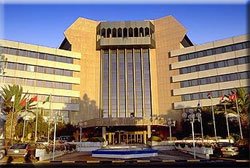 Sheraton Al Hada Hotel
The Islamic philosophy about injuries and accidents became evident to me when I received, as a patient, a lady from Mecca who was related to a Saudi soldier. In SA, if you are related to a member of the military, you are eligible for medical care in a military hospital facility. Now, I know that there must have been neurosurgeons in Mecca, but I was glad to see a patient. The chief of surgery was a Turk and a Muslim, so he rode with the ambulance, the fifty or so miles to Mecca. Outside of Mecca, there is an expressway bypass for non-muslins, as only Muslims can enter the city. This patient was to teach me a lot about how accidents were handled in SA under Islamic philosophy.
The idea is that any event that happens is "God's Will", and to interfere with his will is a big mistake. The lady had been injured in an auto accident several days before. How long she remained at the scene, I do not know, but she did lie on a stretcher in a Mecca hospital for about two days without an IV, etc. After that, she was referred to Al Hada because she was an aunt of a soldier. Then it was OK for us to treat her. Well, the poor thing needed some fluids, etc., and then she should have had a CAT scan. The CAT scan was still being installed, so it was unavailable. Therefore, we did it like the pre-CAT scan days. We put in some burr holes on both sides of her skull. It turned out that she had no surgical lesion or increased intracranial pressure, so the medical people took her over. I spoke with her family again through an interperter after the surgery was over. I told the interperter to relay to them that this patient was not likely to make a good recovery, if indeed, she lived. The lady interperter said that she could not tell them all that at once, but that they should be told over several days. That point became moot, as she died some hours later.
Such things as "God's Will" became a source of some relief for me in that unless I were to deliberately do someone harm, as in a criminal act, there was no such thing as malpractice in SA. Bad results are viewed as faultless. Instead, it is God's Will, and nobody would blame God. The hospital had its own mosque, but in SA, no one but a Muslim can enter a mosque. During prayer times, it was common to see men on their knees facing Mecca to pray. I saw one such man in the hospital parking lot. I later bought a prayer rug to take home. It made an excellent floor mat for my car at the time. I don't think that God minded that at all.
Evenings and weekends were free, and since I had no patients in the hospital most of the time, I could go with Handley and Loren (Loren had purchased a classic old Mercedes and gotten a Saudi driver's license) into downtown Taif. Most of the city was in a state of perpetual construction, since in February, it was to be the site of a Pan-Islamic Conference. The areas of the souq and the nearby street where the telephone exchange was located were open to all. The souq quickly became our favorite place. Maybe one should use the word souq in the pleural because it was like a department store. A clothing souq, a money souq, a gold souq, a food souq,etc. This area was much like an open air market with stalls and small buildings holding all sorts of merchandise.
The three of us frequently ate in the souq in the evening. The crowds were thick, but as non-believers, when all faithful knelt at prayer time, we could easily move about and get ahead of people in lines, etc. One of our favorite places to eat was "Dirty Thobes", a hole in the wall joint where a friendly Arab in a dirty thobe (the robe worn by Arab males) acted as a sort of barker out front in the street. I think that he was also the cook. He became familiar with us, even though we could not converse, to the point that he would invite us into the kitchen to pick out what we wanted. Giant pots full of rice, potatoes, etc. were there. Usually this, along with a broiled chicken was fine. He never understood why we always refused the salad. The vegetables in SA are gorgeous, but are fertilized with "night water", or raw sewage. No one of us ever got a GI problem, but we were judicious in our intake. Foreigners must adjust there thinking about flies in SA. They are everywhere, and you can become used to them. Thobe's had asingle cold water sink to one side where we washed our hands before eating. All the Saudi customers ate with their hands and washed AFTER they finished. After a meal there, we could go to another spot in the souq to have a delicious crepe-like dish made of a crepe, bananas, sugar, and butter, all rolled together and steamed. Other dishes that we sampled were a Saudi hot dog, which was what everyone knows now as a Kebap. We found Tabasco sauce in SA along with these. I have often tried to reproduce the wonderful rice dish at Dirty Thobe's place. It had whole cloves, cardamons tumeric, and all sorts of spices in it, and I could eat it by the bowl. Along with our meals we always had alcohol-free beer. I never realized how many beer companies made this beer for export to SA. Try Schlitz, Miller, etc. for example. Dirty Thobe would step next door to a kiosk and fetch it for us. While in the souq, I usually would buy dates and olives, both of which I snacked on out of my room refrigerator. They were delicious!
The souq held many other things besides food. Handley and I bought thobes for ourselves, as well as the head dress typical of Arab men. There were camel skin bags big enough to carry a small child, all sorts of electronics and tapes. Tapes were openly counterfeited while you waited. Gold at that time was about eight hundred dollars an ounce. In SA gold is sold by the gram, so you pay for the weight and not the workmanship. SA women have arms full of gold bracelets. I wanted a fifty Peso Mexican gold coin to take home, so I enquired around and found a young man who knew where I could buy one. He took me by the hand and led me to a place in the gold souq. I will always remember being led down the street, holding hands with a young man, while Loren ran along behind us laughing. It is accepted in SA, for males to hold hands while walking. That would have never flown in Alabama. Anyway, I got the coin.
In Taif, as in all SA cities and towns, there were small open storefronts with tables and open double tiered seats like bunk beds where men congregated to drink sweet tea and smoke Hooflahs. These contraptions were small to huge and consisted of a column of brass set on a pot filled with water, and a tube leading to a mouthpiece. One puts a sweeted tobacco in the top, lights it, and then puffs away. I found one of these in a souq and brought it and a can of the tobacco home to the states. Phone calls to the USA were at a premium, but once a week, I could go to the phone souq, wait in a room full of folks, and then make a pre-paid call.
The role of women gets and has gotten, a lot of press in the western world. In SA, women are restricted in public. You see no Saudi woman in public not covered, face, arms, and legs. Western women are advised to cover all but the face. A woman's bare legs are subject to being sprayed with black paint by the religious police if seen. Women do not go out in public alone. They must be with other women or a husband. An unmarried woman with a man without a chaperone woman along is considered an adulteress or prostitute, both are which are a no-no. Women do not work or drive cars, and this applies to western women also. In the compounds, this can cause a lot of distress among wives. Unless they have a job teaching, they play bridge. It is a hard existence for them otherwise. On the other hand, I have seen men driving a car with one or more women in the back seat, shaking fingers at him and verbally giving him the devil. You never acknowledge a man's wife either in public or by asking her health, etc. in private. I am told that behind the door of a family home, it is another matter entirely regarding male-female relationship. The woman is boss. The Koran has specifics on men and women. Their children belong to the man. The man is obligated to care for his wives, no matter how many. Divorce is his prerogative, but he should see that his former wife does not go hungry, etc. If she has been unfaithful, that is another matter.
Saudi punishments are severe and delivered by Islamic law. One pays "blood money" for manslaughter. At the time I was in the kingdom, it was thirty thousand dollars or equivalent. Theft is punished by removal of the right hand with a sword. The right hand is always used for eating and shaking hands. The left is used only for personal hygiene, so this is a stigma for life. Adultery is punished by stoning. The person to be stoned is buried up to the chin, and people are encouraged to thrown softball sized stones at the head. If one can extricate themselves before losing consciousness, one if free (but likely has a bad headache). Murder is punished by beheading, always with a confession of the guilty. This is done with a sword and always, as with all punishments, on Friday afternoons after prayers. If the victim's family forgives the murder, the life may be spared. There are no appeals otherwise, and punishment is swift (usually the week of the deed). Punishments are public and youngsters and foreigners are pushed to the front so they may see well. So much for deterrence! The executioner for Taif also happened to be the head gardener at the hospital, so I saw him often in his "other job". He was aid to be an excellent swordsman with a clean cut always. I never saw any punishment, but we christened the spot "Chop Chop Square". There were several beheadings in Mecca and Ryhad while I was in the country as reported in the newspaper.
Regular paydays were held in the hospital, and of course were popular events. On my first payday, I went down to the basement mail room where the salaries were paid. To my surprise, the man in the cashier's cage pushed a huge stack of Saudi Ryals to me. It was more than I could fit into all my pockets, so I put the notes into a sack. There was no way to handle all this, so I took a few hundred Ryals for incidentals and headed off to the bank in Taif. The bank scene reminded me of the Jeddah airport. Total chaos with people pushing and shoving. Jumping lines is an accepted custom in SA, so it is like musical chairs sometimes. Anyway, while all this was going on, Bingo!, it was prayer time. I found myself standing amongst a floor full of praying Saudis. I simply went to the head of a teller's line and grabbed onto the bars at his gate. He arose after praying, and I was number one. He told me that for traveler's checks, I needed to go to the balcony and see another man. This man was an old Arab in a beautiful gray thobe who had good English. He fixed me up with US Dollar traveler's checks and took my Ryals. Then he said that "sometime soon" I should sign the checks. I did that at his desk. Where have you ever taken a blank traveler's check out of a bank without them insisting on this at once? Theft was not likely, but who takes chances?
27 April 2006
Six Degrees of Separation
We all have said, "It is a small world, isn't it?", before when we meet someone who also knows a friend or acquaintance who we also know. Well, the world is a lot smaller than you think, and it has been fairly well substantiated. Barbara is the one who brought this to my attention, but once you are aware of it, you keep finding examples.
Supposedly, every person is connected to another by no more than four other people, or six degrees of separation. Theoretically, that means that A and B would know each other if A asked four people if they knew B. Some one of those four would be able to say yes. There is a similar theory in dictionary use. If a word researched has links to other words, then by following these links six times, one would be able to find any word that has links. The theory is that we all have a circle of acquaintances, and by each searching their database, overlaps will occur.
Now remember, this a hypothesis, not a guarantee. Of course it doesn't work every time, but it is uncanny how often it does. For instance, some years ago, I had a friend who was a retired teacher. We saw each other a few times in Georgia and each time he came to CH. I also knew two ladies who visited CH often and were retired teachers. Neither man or the two women knew each other. They both knew me. At a meeting of retired teachers in Georgia, they happened to meet and exchange information about their Swiss trips. Not only did they both know me, but they also knew my landlady here in CH.
One of my daughters has a position with Tennessee Economic Development. One of her favorite contacts is a man who I knew when in High School. He and I have not seen each other in fifty years, but he works at times with my daughter. She also works with two other people who I never met, but whose relatives were friends of mine or my parents.
We know a women here in Sachseln who would be called a mayor in the US. She has a sister who lives in San Francisco. A lady who visits Sachseln as a tourist was at a party in San Francisco and saw a woman in a particularly pretty sweater. She asked her where she had found this clothing. The lady told her it had been a gift from her sister in Sachseln, Switzerland (our "mayor"). I know both the US tourist and the "mayor".
Six Degrees of Separation was first popularized by a psychologist named Stanley Milgram who went about having people send letters and packages to people in other cities and tried to prove that we are interconnected by no more than six other people that we know. In other words, one person knows no more than six people who know you. Various efforts have been made to show this with results varying from 5 to 97%.
I took part in this study not long ago. It is being done at Columbia University. If you are interested go to
http://smallworld.columbia.edu/
I did not receive any results from query (so far).
Supposedly, every person is connected to another by no more than four other people, or six degrees of separation. Theoretically, that means that A and B would know each other if A asked four people if they knew B. Some one of those four would be able to say yes. There is a similar theory in dictionary use. If a word researched has links to other words, then by following these links six times, one would be able to find any word that has links. The theory is that we all have a circle of acquaintances, and by each searching their database, overlaps will occur.
Now remember, this a hypothesis, not a guarantee. Of course it doesn't work every time, but it is uncanny how often it does. For instance, some years ago, I had a friend who was a retired teacher. We saw each other a few times in Georgia and each time he came to CH. I also knew two ladies who visited CH often and were retired teachers. Neither man or the two women knew each other. They both knew me. At a meeting of retired teachers in Georgia, they happened to meet and exchange information about their Swiss trips. Not only did they both know me, but they also knew my landlady here in CH.
One of my daughters has a position with Tennessee Economic Development. One of her favorite contacts is a man who I knew when in High School. He and I have not seen each other in fifty years, but he works at times with my daughter. She also works with two other people who I never met, but whose relatives were friends of mine or my parents.
We know a women here in Sachseln who would be called a mayor in the US. She has a sister who lives in San Francisco. A lady who visits Sachseln as a tourist was at a party in San Francisco and saw a woman in a particularly pretty sweater. She asked her where she had found this clothing. The lady told her it had been a gift from her sister in Sachseln, Switzerland (our "mayor"). I know both the US tourist and the "mayor".
Six Degrees of Separation was first popularized by a psychologist named Stanley Milgram who went about having people send letters and packages to people in other cities and tried to prove that we are interconnected by no more than six other people that we know. In other words, one person knows no more than six people who know you. Various efforts have been made to show this with results varying from 5 to 97%.
I took part in this study not long ago. It is being done at Columbia University. If you are interested go to
http://smallworld.columbia.edu/
I did not receive any results from query (so far).
Gigli's Trip to Another Planet Part 2
During my tour of the hospital, I met some of the doctors already there. I think that I was the only one there on a trial basis, since a lot of them had families with them. The whole place was brand new. It had been opened about three months before. The only native Saudi doctor in the whole place was an anesthesiologist who had trained at the Mayo Clinic. There were a few Americans, some Brits, some Canadians, and a Turk or two. Although I only became close with a couple, the rest were quite congenial and all seemed to be well trained. The nursing staff was predominately British, American, and Canadian in supervisory roles and Filipino as floor nurses. They all tended to interact with doctors a bit more pleasantly than their USA counterparts, but that is a two way street.
One of my first surprises was the fact that the hospital had NO real neurosurgical operating instruments. Never fear, my predecessor had already ordered them ,and they were to be in the kingdom shortly. More about that later. I was asked to tell them when I wanted to have clinic and when I wanted to schedule operating times. There were general surgery, ophthalmologic, ENT, dental, and other procedures up and running. There was an active OB-GYN service also. The clinics were both in the hospital and in downtown Taif. The latter was the most interesting by far, as was a visit several times to the old Taif hospital. In this facility, likely built during the Ottoman Empire, one felt like he was far removed from the modern world outside.
After the hospital tour, I was taken, along with my bags to The Sheraton Al Hada Hotel. I was led to believe that this was only for a short time before I was to be moved to a spot in one of the several dormitories in the hospital compound. Truth became, I was a resident of this hotel for the duration. That was not bad, I had a beautiful room for two facing the hospital about a mile away, with a nice bath (with bidet), an alcove on entering held a small refrigerator. Bottled water was delivered daily, and it was used even for tooth brushing. The hotel had a coffee shop where I frequently had a continental breakfast, and I was picked up each AM by the hospital van. In those days, the knees were in marathon shape, so I usually was up before daylight to run down the hill from the hotel and onto the expressway that ran by the hotel's site and contained no traffic.
It was downright cold in the early AM, but nice and quiet. The prayer call from the mosque would begin at daybreak, and the kids would begin to come out of the dessert to wait for a school bus. The children are beautiful and anxious to see people who don't look like themselves. Once the girls reach puberty, things change. They are veiled, and if I approached one on foot, she would move away and turn her back. Occasionally, I would meet a goat or two, since animals and cars share the expressway. Only as one got close to Taif about ten miles away, did the cars appear and use appropriate lanes. I was told that these nice roadways had been built by Scandinavian companies. Saudi drivers were on the par with those in bumper cars that one rides at carnivals, etc.
On my first day in the hospital, I renewed my orientation and found that there was little to do. My two closest friends in SA were to be Handley Coles and Loren Ryan. Handley was a British pediatrician in SA on a two year contract. He lived in retirement in Wales, and like many Brits, he needed the money even in retirement. Loren was a neurologist from California, divorced, and there for reasons that I never really explored. Both guys were fun, and we all lived in the hotel, played a lot of gin rummy, and talked about drinking gin a lot. I had taken the pledge on arrival in the kingdom, thinking that when in the kingdom, do as the kingdom says. Loren and Handley were not of that mind.
Saudi Arabia is alcohol free, but be sure that does not mean there isn't plenty to be had. There was a thriving business in homemade "hootch", and in all the foreign compounds, bars could be found. Drunkenness was punished by whipping, so drinkers were smart to stay in their compounds when imbibing. Drugs likewise were banned, but I learned that members of the royal family, especially, the young princesses were prone to addiction. My tour in SA included the holidays of Thanksgiving, Christmas, and New Years' Eve. This was cause for me to be a designated driver on at least one of those days. I'll remember that because while sitting in a bar in the compound of a large armament company, I had occasion to talk with an interesting character while Handley and Loren were getting polluted. His name was "Fast Eddie". He was an American who ran booze from some where up near Israel down through the dessert to Taif. At ninety dollars a fifth for a bottle of scotch, he must have been doing OK. If he had been caught, it would not have been pleasant if he lived. The bedouins would have robbed and killed him, or the religious police would have jailed him. I never saw a Saudi jail, but I was told that if jailed, a person's family was responsible for his food and water. The jails didn't run a hospitality service.
Days at the hospital consisted mostly of reading in the library, walking the compound, eating lunch, and generally trying to pass the time. On clinic days, I would go into town with Loren to a few patients. Occasionally, there was a consult to see in the town hospital, but mostly I just waited for this load of neurosurgical equipment sure to be just around the corner. Well, it turned out that this stuff arrived two days before I left in mid-January! Lot of good that did me. I did a sum total of three cases in two months; not a week's activity back in Alabama. The Saudis had so much money that they had taken my predecessor's order list and DOUBLED it! There was enough neurosurgical equipment for TWO hospitals when I left, and as far as I know, there was no new man immediately following me.
My three cases were done with some orthopedic instruments that one of the surgical nurses put together for me to approve. She was one of those scrub nurses that could anticipate what I wanted as I realized it myself. We did two herniated lumbar discs and burr holes for a closed head injury. One of the discs was on a Saudi's wife, and the other was on a Royal Air Force pilot who had trained in TX and IL. Both were happy with their results, as was I. The woman and her husband spoke no English, so one of the Jordanian women translators helped me on rounds etc. On discharge, her husband presented me with a brand new Gruen wrist watch. As I thanked him, the translator cautioned me not to be too appreciative, or else the man would not think highly of me. The pilot patient and I had some interesting conversations. He was congenial but frank in his assessment of western values. "You have your rules and laws, and we have ours, but we abide by ours." Apparently western culture in a big US city such as Chicago had turned him off. The closed head injury will come in another chapter.
One of my first surprises was the fact that the hospital had NO real neurosurgical operating instruments. Never fear, my predecessor had already ordered them ,and they were to be in the kingdom shortly. More about that later. I was asked to tell them when I wanted to have clinic and when I wanted to schedule operating times. There were general surgery, ophthalmologic, ENT, dental, and other procedures up and running. There was an active OB-GYN service also. The clinics were both in the hospital and in downtown Taif. The latter was the most interesting by far, as was a visit several times to the old Taif hospital. In this facility, likely built during the Ottoman Empire, one felt like he was far removed from the modern world outside.
After the hospital tour, I was taken, along with my bags to The Sheraton Al Hada Hotel. I was led to believe that this was only for a short time before I was to be moved to a spot in one of the several dormitories in the hospital compound. Truth became, I was a resident of this hotel for the duration. That was not bad, I had a beautiful room for two facing the hospital about a mile away, with a nice bath (with bidet), an alcove on entering held a small refrigerator. Bottled water was delivered daily, and it was used even for tooth brushing. The hotel had a coffee shop where I frequently had a continental breakfast, and I was picked up each AM by the hospital van. In those days, the knees were in marathon shape, so I usually was up before daylight to run down the hill from the hotel and onto the expressway that ran by the hotel's site and contained no traffic.
It was downright cold in the early AM, but nice and quiet. The prayer call from the mosque would begin at daybreak, and the kids would begin to come out of the dessert to wait for a school bus. The children are beautiful and anxious to see people who don't look like themselves. Once the girls reach puberty, things change. They are veiled, and if I approached one on foot, she would move away and turn her back. Occasionally, I would meet a goat or two, since animals and cars share the expressway. Only as one got close to Taif about ten miles away, did the cars appear and use appropriate lanes. I was told that these nice roadways had been built by Scandinavian companies. Saudi drivers were on the par with those in bumper cars that one rides at carnivals, etc.
On my first day in the hospital, I renewed my orientation and found that there was little to do. My two closest friends in SA were to be Handley Coles and Loren Ryan. Handley was a British pediatrician in SA on a two year contract. He lived in retirement in Wales, and like many Brits, he needed the money even in retirement. Loren was a neurologist from California, divorced, and there for reasons that I never really explored. Both guys were fun, and we all lived in the hotel, played a lot of gin rummy, and talked about drinking gin a lot. I had taken the pledge on arrival in the kingdom, thinking that when in the kingdom, do as the kingdom says. Loren and Handley were not of that mind.
Saudi Arabia is alcohol free, but be sure that does not mean there isn't plenty to be had. There was a thriving business in homemade "hootch", and in all the foreign compounds, bars could be found. Drunkenness was punished by whipping, so drinkers were smart to stay in their compounds when imbibing. Drugs likewise were banned, but I learned that members of the royal family, especially, the young princesses were prone to addiction. My tour in SA included the holidays of Thanksgiving, Christmas, and New Years' Eve. This was cause for me to be a designated driver on at least one of those days. I'll remember that because while sitting in a bar in the compound of a large armament company, I had occasion to talk with an interesting character while Handley and Loren were getting polluted. His name was "Fast Eddie". He was an American who ran booze from some where up near Israel down through the dessert to Taif. At ninety dollars a fifth for a bottle of scotch, he must have been doing OK. If he had been caught, it would not have been pleasant if he lived. The bedouins would have robbed and killed him, or the religious police would have jailed him. I never saw a Saudi jail, but I was told that if jailed, a person's family was responsible for his food and water. The jails didn't run a hospitality service.
Days at the hospital consisted mostly of reading in the library, walking the compound, eating lunch, and generally trying to pass the time. On clinic days, I would go into town with Loren to a few patients. Occasionally, there was a consult to see in the town hospital, but mostly I just waited for this load of neurosurgical equipment sure to be just around the corner. Well, it turned out that this stuff arrived two days before I left in mid-January! Lot of good that did me. I did a sum total of three cases in two months; not a week's activity back in Alabama. The Saudis had so much money that they had taken my predecessor's order list and DOUBLED it! There was enough neurosurgical equipment for TWO hospitals when I left, and as far as I know, there was no new man immediately following me.
My three cases were done with some orthopedic instruments that one of the surgical nurses put together for me to approve. She was one of those scrub nurses that could anticipate what I wanted as I realized it myself. We did two herniated lumbar discs and burr holes for a closed head injury. One of the discs was on a Saudi's wife, and the other was on a Royal Air Force pilot who had trained in TX and IL. Both were happy with their results, as was I. The woman and her husband spoke no English, so one of the Jordanian women translators helped me on rounds etc. On discharge, her husband presented me with a brand new Gruen wrist watch. As I thanked him, the translator cautioned me not to be too appreciative, or else the man would not think highly of me. The pilot patient and I had some interesting conversations. He was congenial but frank in his assessment of western values. "You have your rules and laws, and we have ours, but we abide by ours." Apparently western culture in a big US city such as Chicago had turned him off. The closed head injury will come in another chapter.
25 April 2006
Gigli's Trip to Another Planet Part 1
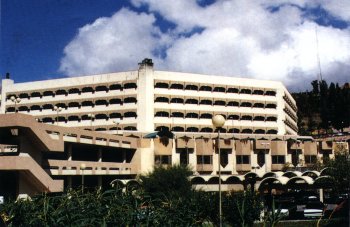
Al Hada Hospital (r)
Back in 1980-1981, it became somewhat advantageous for me to take a trip out of the country. Now, this wasn't because I was on the lam, or something like that. It was just a matter of expedition in a civil matter.
I found an ad in the back of a medical magazine looking for doctors to go overseas. My partner agreed to a sabbatical, so I called these people. It was a national medical company that managed hospitals in the USA and other countries. I spoke with a recruiter who sounded interested in me. I agreed to meet him in Dallas which was half way between us to be interviewed and get details on his offer to post me to a hospital in Saudi Arabia. The meeting went well enough, but he was looking for someone to make a two year commitment. I told him there was no way that I would consider going to Saudi Arabia on a two year contract without trying it out for a shorter period. He said he could offer a two month trial with an option for two years after that. I did not know then that the neurosurgeon present at the post then was leaving, so needs were urgent.
It was set up for me to be in SA from 15 November until 15 January. Over the next several weeks, I received literature on SA, got my shots up to date, and made preparations to leave. I had never been to SA, so it sounded interesting. I was to be flown from Atlanta to Dulles, then to London and onward to SA where I would spend a night in Jeddah and get picked up to travel by car to Taif. Taif is the summer capitol of SA. The king moves the whole government from Riyadh to Taif for 3 months each year because at 7000 feet above sea level, Taif is cooler. I was to work in a military hospital near Taif called Al Hada. This was a brand new facility. More about that to come.
In those years, SA was pulling in several BILLION dollars A DAY from the sale of oil. That had so much money that they couldn't spend or invest it all. Therefore, the sky was the limit. The flight over and back was all first class, I was put up in The Sheraton Al Hada hotel in a nice double room for two months, I could have all my meals free in the hospital, and the salary was generous. So, I hopped the plane in Atlanta ready to transfer in Dulles for the ride to London. Whoops! I got to Dulles with only one of two suitcases. I called my contact in California and assured him that I was not about to leave the USA for SA without both suitcases. No mind, just check in at the airport hotel, and they would find the baggage. Sure enough, the next evening, I was off with both suitcases, on my journey.
Talk about another planet! The trip to London and on to Jeddah was uneventful. First class is grand, especially if someone else is paying the bill. Saudia, the national SA airline was the last leg from London to Jeddah, so I learned to drink cardamom coffee. The Kingdom bans all alcohol, so there was no wine list. We arrived in Jeddah at about one AM SA time, to be greeted with a blast of the hottest air I had experienced in a long time. Winter in SA means temperatures of the upper nineties. The Jeddah airport was a mess. I mean a Chinese fire drill gone bad mess. Yelling and screaming in Arabic, no English whatsoever, no usable phones, AND no one there to meet me. After I went through a search in which customs wanted to make sure that I had no bibles, Christian symbols, booze, or pornography, I finally got some money changed. Talk about culture shock, I was blown away, hot, and jet lagged. Then up comes this kid of maybe fifteen years who did have a few words of English. He had a taxi and would drive me to the Hyatt in downtown where I was booked and to meet the ride to the hospital the next morning. The streets in Jeddah may be paved, but the dessert covers that, so we roared off in a cloud of dust with this kid driving like there was no tomorrow. We made it to the hotel, I paid junior off, and went to bed.
The next morning I was met along with three other folks by a hospital representative who was to drive us about sixty miles up to Taif. No matter what one says, the landscape was striking, and the trip up the escarpment to Taif was impressive. Al Hada is a name for a mountain near Taif, and the hospital was named after it. It sat at the foot of the mountain, and it looked beautiful and new. The several buildings sit inside a compound off a big autobahn with little or no traffic. Once we reached the main building, I was met by a doctor who was to be my guide. I mentioned that I wanted to store my bags somewhere, and he said to just leave there by the front door. They would be perfectly fine. When I questioned that, he said that there would be no theft, since one gets the right hand axed off for stealing. When I returned several hours later, there were my bags.
Since the hospital dorms were full, surplus personnel were being housed at the Sheraton within walking distance on a hill near the hospital. This was to be a temporary measure, but I stayed there for two months. A real adventure was to begin!
13 April 2006
World War Two and "J"
I have a friend who I'll call "J". She is a quintessential Grand Dame, but she is also one of the most engaging and kind people that I have met in a very long time. She is French, but she has been married to a Swiss man and has been in CH for many, many years. When I found out that she grew up in Paris during WW II, I asked if I might sit down and interview her about her life there when the Germans were in control of the city. J was born in 1924, so you can see that she is in her ninth decade. Despite that, she looks my age, and has a wonderful mind. There must be a batch of good genes in her makeup.
Our interview took place in her living room in a village near where I live. I might add it looks like a museum. She divides WW II into the "funny war" and the "real war". The funny war was that prior to Hitler's invasion of Poland in 1939. It wasn't looked on as a world war with Europe being a prize, but when Poland was invaded, it became a prelude to WW II. When Japan and the USA entered, it was a true world war. She was sixteen years old and a student when Poland was invaded. She spent some time in England about the same time, as her father felt she should learn English. She made it back to France before the Germans invaded, much to the relief of her family.
First, a bit about J. Her family lived in a well to do Paris suburb, Neuilly. Her father was the owner of an engineering and manufacturing concern that did business all over Europe. He had been in World War I and had been seriously wounded. He did recover but was always a fan of the USA because of their help in WW I. The family had a home in the south of France and a country house about forty miles out of Paris where they had sharecroppers to help. They welcomed a Swiss girl into their house who wanted to earn some money and learn French. This continues today to be a way that young Europeans learn a foreign language. It so happened that this young girl was from the village of Engelberg here in central CH. Through this contact, the two families became friends, and it was not long until ski holidays, as well as summer vacations were often spent in Engleberg. The significance of this will become evident later.
As the war progressed, it was certain that France, including Paris, was going to be occupied by the German advance. This, of course, took place with a puppet government, Vichey, being installed. J says that General Petan, the titular head of state was mentally incompetent and a true puppet. I was curious about how this young girl fared in the occupation. J had originally wanted to study medicine, but the war prevented that pursuit. She did however, at her father's suggestion,begin a course in Red Cross training to become a nurse. She lived on the eastern side of Paris, and all the hospitals were on the western side. Her means of transport was her bicycle. Bicycles were the universal means of travel then because there was no fuel for cars. It seems that as long as she minded the curfew, life could go on in the city for her and her education.
Rationing was in full swing. The goods available with coupons were shoddy, and things such as shoes were made out of cardboard. J had a pair of pre-war shoes that were leather with rubber soles. These were her treasure and lasted the war. Food was scarce, coffee was non-existent, and things such as fruit not to be found. She told me of how her father had their pre-war Mercury sedan cut and modified so that it would run on charcoal. Evidently, this was done with steam. They could make trips to their farm where peasants would get them some vegetables and a bit of milk now and then. The country house had been requisitioned by the Germans, but the peasants had emptied it of some furnishings that the family could retrieve after the war was over. There was a thriving black market in Paris, but the punishment for using it was extreme ( a trip to a concentration camp).
J remembers that several Jewish families just disappeared from her neighborhood. No trace left. It soon became common knowledge of what Hitler was doing to the Jews. J is a catholic, but had Jewish school friends just not show up for school and never be heard from again. She did know of one family that was sent to Ravensbruck. The NAZI propaganda was everywhere. Most of the movies were just that, although occasionally, there would be a French movie worth seeing. During the whole occupation J never was spoken to, or spoke to, a German soldier. She remembers always having a feeling of fear. Some of her friends were disappearing, the family house in southern France was bombed and destroyed, the country house was occupied and looted, she saw one dogfight while in the country around that house where two planes were shot down in the adjacent woods. They found one plane without a pilot, and another where two men had died. She remembers the fear that her father would be caught listening to the BBC from London. A trip to a camp would have been his punishment, but they could learn the true progress of the war and that the allies were on their way. The Germans used triangulation trucks to try and find these radios. These would roam their neighborhood at night.
J remembers the day that the Germans packed up and left their country home where earlier a German soldier had brought her mother a pheasant that he had shot on their own land. Her mother coolly told the soldier that they wanted nothing that the Germans had to offer. A few days later, the Germans left Paris, supposedly because they were needed on the Eastern Front. They had agreed not to destroy the city although the entire place was rigged with explosives. Of course, we all have seen pictures of the allied soldiers welcomed in Paris.
In a few months, the war in Europe was over. J had been engaged to a French soldier who was not a favorite of her father because he had no job. Her father had been the one to get this man into the French army, and he told J later that he suspected the father was hopeful of a battlefield exit for him. When this didn't happen, her father made arrangements for her to go with a Godmother to the Godmother's property in Argentina. The two women spent a month or so traveling on a ship and seeing about the Godmother's holdings there. By this time the engagement had dissolved.
J returned to France and began to work as a nurse with the allied medical services in the Office of Strategic Services. The OSI was the precursor of today's CIA. Soon afterwards, she and a group of other personnel were on their way into Germany when the jeep she was riding in had a wreck. She was ejected and suffered a compression fracture of her spine. This required a hospital stay of several weeks, and she still has the discharge summary from the US Medical Unit near Hamburg. The accident ended her military career and her OSS position as a Lieutenant in the US forces.
Shortly after the end of the war, she found herself once again in CH and in Engelberg of all places. She met a nice young Swiss man who had grown up in Engelberg where his parents owned a hotel. Soon, it became apparent that they would get married, they did, and to this day have a place in Engelberg. What a circle this has been for a girl of six or seven to a woman returning to Engelberg to find her mate, have three children, and remain with him to this day.
J showed me a grand collection of postcards and old photos which I am sure her children and grandchildren will find a valuable source of this lady's life story. My afternoon with her was full of surprises. Her story would make a grand novel, and it serves to remind me that here in Europe, every older person must have a story to tell. I am grateful that we had this time together. She knows of my intention to blog this part of her life history, and I am very happy to do this.
Our interview took place in her living room in a village near where I live. I might add it looks like a museum. She divides WW II into the "funny war" and the "real war". The funny war was that prior to Hitler's invasion of Poland in 1939. It wasn't looked on as a world war with Europe being a prize, but when Poland was invaded, it became a prelude to WW II. When Japan and the USA entered, it was a true world war. She was sixteen years old and a student when Poland was invaded. She spent some time in England about the same time, as her father felt she should learn English. She made it back to France before the Germans invaded, much to the relief of her family.
First, a bit about J. Her family lived in a well to do Paris suburb, Neuilly. Her father was the owner of an engineering and manufacturing concern that did business all over Europe. He had been in World War I and had been seriously wounded. He did recover but was always a fan of the USA because of their help in WW I. The family had a home in the south of France and a country house about forty miles out of Paris where they had sharecroppers to help. They welcomed a Swiss girl into their house who wanted to earn some money and learn French. This continues today to be a way that young Europeans learn a foreign language. It so happened that this young girl was from the village of Engelberg here in central CH. Through this contact, the two families became friends, and it was not long until ski holidays, as well as summer vacations were often spent in Engleberg. The significance of this will become evident later.
As the war progressed, it was certain that France, including Paris, was going to be occupied by the German advance. This, of course, took place with a puppet government, Vichey, being installed. J says that General Petan, the titular head of state was mentally incompetent and a true puppet. I was curious about how this young girl fared in the occupation. J had originally wanted to study medicine, but the war prevented that pursuit. She did however, at her father's suggestion,begin a course in Red Cross training to become a nurse. She lived on the eastern side of Paris, and all the hospitals were on the western side. Her means of transport was her bicycle. Bicycles were the universal means of travel then because there was no fuel for cars. It seems that as long as she minded the curfew, life could go on in the city for her and her education.
Rationing was in full swing. The goods available with coupons were shoddy, and things such as shoes were made out of cardboard. J had a pair of pre-war shoes that were leather with rubber soles. These were her treasure and lasted the war. Food was scarce, coffee was non-existent, and things such as fruit not to be found. She told me of how her father had their pre-war Mercury sedan cut and modified so that it would run on charcoal. Evidently, this was done with steam. They could make trips to their farm where peasants would get them some vegetables and a bit of milk now and then. The country house had been requisitioned by the Germans, but the peasants had emptied it of some furnishings that the family could retrieve after the war was over. There was a thriving black market in Paris, but the punishment for using it was extreme ( a trip to a concentration camp).
J remembers that several Jewish families just disappeared from her neighborhood. No trace left. It soon became common knowledge of what Hitler was doing to the Jews. J is a catholic, but had Jewish school friends just not show up for school and never be heard from again. She did know of one family that was sent to Ravensbruck. The NAZI propaganda was everywhere. Most of the movies were just that, although occasionally, there would be a French movie worth seeing. During the whole occupation J never was spoken to, or spoke to, a German soldier. She remembers always having a feeling of fear. Some of her friends were disappearing, the family house in southern France was bombed and destroyed, the country house was occupied and looted, she saw one dogfight while in the country around that house where two planes were shot down in the adjacent woods. They found one plane without a pilot, and another where two men had died. She remembers the fear that her father would be caught listening to the BBC from London. A trip to a camp would have been his punishment, but they could learn the true progress of the war and that the allies were on their way. The Germans used triangulation trucks to try and find these radios. These would roam their neighborhood at night.
J remembers the day that the Germans packed up and left their country home where earlier a German soldier had brought her mother a pheasant that he had shot on their own land. Her mother coolly told the soldier that they wanted nothing that the Germans had to offer. A few days later, the Germans left Paris, supposedly because they were needed on the Eastern Front. They had agreed not to destroy the city although the entire place was rigged with explosives. Of course, we all have seen pictures of the allied soldiers welcomed in Paris.
In a few months, the war in Europe was over. J had been engaged to a French soldier who was not a favorite of her father because he had no job. Her father had been the one to get this man into the French army, and he told J later that he suspected the father was hopeful of a battlefield exit for him. When this didn't happen, her father made arrangements for her to go with a Godmother to the Godmother's property in Argentina. The two women spent a month or so traveling on a ship and seeing about the Godmother's holdings there. By this time the engagement had dissolved.
J returned to France and began to work as a nurse with the allied medical services in the Office of Strategic Services. The OSI was the precursor of today's CIA. Soon afterwards, she and a group of other personnel were on their way into Germany when the jeep she was riding in had a wreck. She was ejected and suffered a compression fracture of her spine. This required a hospital stay of several weeks, and she still has the discharge summary from the US Medical Unit near Hamburg. The accident ended her military career and her OSS position as a Lieutenant in the US forces.
Shortly after the end of the war, she found herself once again in CH and in Engelberg of all places. She met a nice young Swiss man who had grown up in Engelberg where his parents owned a hotel. Soon, it became apparent that they would get married, they did, and to this day have a place in Engelberg. What a circle this has been for a girl of six or seven to a woman returning to Engelberg to find her mate, have three children, and remain with him to this day.
J showed me a grand collection of postcards and old photos which I am sure her children and grandchildren will find a valuable source of this lady's life story. My afternoon with her was full of surprises. Her story would make a grand novel, and it serves to remind me that here in Europe, every older person must have a story to tell. I am grateful that we had this time together. She knows of my intention to blog this part of her life history, and I am very happy to do this.
10 April 2006
Can This Be True?
For several years, Barbara and I have been covered by Swiss medical insurance. It seems that after a law was passed, we had to do this in order to remain here. Our insurance in Britain was no longer acceptable.
In CH, there is universal health insurance coverage for all persons. All insurance companies in CH have to accept you for the obligatory coverage, no matter what, and this coverage cannot be cancelled, even for non-payment of premiums. If a single person has less than 15,000 CHF income, their premiums are paid by the kanton. I am sure that there is sliding scale for man and wife, couples with children, etc., but I have no reason to know what exactly.
That means that every patient has insurance. The coverage can vary, if you want more bells and whistles, but the basic policy remains the same. For instance, Barbara and I have the highest deductible allowed. We are also covered outside the country (in the USA paid at double the benefits for 6 weeks). If we can't get back to CH in 6 weeks, it likely won't matter for us.
Now, I read about the Massachusetts legislature passing what seems to be the same universal coverage law. Other states are looking at it closely too. Below are the main points taken from the Providence Journal newspaper.
________________________________________________________
In CH, there is universal health insurance coverage for all persons. All insurance companies in CH have to accept you for the obligatory coverage, no matter what, and this coverage cannot be cancelled, even for non-payment of premiums. If a single person has less than 15,000 CHF income, their premiums are paid by the kanton. I am sure that there is sliding scale for man and wife, couples with children, etc., but I have no reason to know what exactly.
That means that every patient has insurance. The coverage can vary, if you want more bells and whistles, but the basic policy remains the same. For instance, Barbara and I have the highest deductible allowed. We are also covered outside the country (in the USA paid at double the benefits for 6 weeks). If we can't get back to CH in 6 weeks, it likely won't matter for us.
Now, I read about the Massachusetts legislature passing what seems to be the same universal coverage law. Other states are looking at it closely too. Below are the main points taken from the Providence Journal newspaper.
________________________________________________________
Key provisions of the Massachusetts health care plan
01:00 AM EDT on Monday, April 10, 2006
_______________________________________________________
This seems to make good sense to me. I just have to ask what are the objections by anyone? Why did it take so long?
This seems to make good sense to me. I just have to ask what are the objections by anyone? Why did it take so long?
04 April 2006
Be True to Your School
I do not consider myself a literary critic of any importance. I do like to read, and there is a very short list of books that I have not been able to finish at least. A friend recently told me about a book with the title of this blog by a guy named Bob Greene. Now Bob has been in a bit of hot water and has been somewhat disgraced by his former professionals in the newspaper business. I don't care to make a judgment about that.
What I do want you to know is that this guy followed me around day and night in my high school years. I didn't know that I was being followed, God forbid! He did this though, and we even had some of the same friends. He did all this, and I never had a clue. The only real difference is that he kept a daily journal in 1967, and I never gave a journal a thought. I was a bit ahead of his time, in that my high school days ended in 1957, but I still think he was shadowing me. He says all the events in the book are true, as are the people real. He has changed a few names to protect a few dignities, and I am sure that I am one of those.
Bob Greene was a tennis player in high school. Our school had no tennis team. We still had some of the same coaches and teachers too. He seems to go out for every meal. I don't know where he got that kind of money to spend at the Toddle House, but I went to Toddle Houses too. Greene had some of my teachers, even if he lived in Ohio and I lived in Tennessee. Mr. Schacht, his algebra teacher sounds like Mr. Shelton, my algebra teacher for one day (he died that night, not due to my presence, he just died). Greene also had a group of friends uncannily similar to the same rogues that I had as friends.
Greene's book is a nice read because you can read entries for one or two days, a week, or longer if you wish. Greene and I did a lot of cruising in cars and on foot, sometimes with cohorts and sometimes alone. He and I both had a first love, and he went through the same bittersweet agonies as I did. He and his buddies would go to other towns to meet new girls just like Ashby and I used to go to Humbolt and Memphis in his mom's hot-wired Caddy for the same thing.
Greene's school had fraternities and sororities like mine. That's a whole other blog entirely, and likely now, it is an anachronism.
More about this book, as I finish the last half.
What I do want you to know is that this guy followed me around day and night in my high school years. I didn't know that I was being followed, God forbid! He did this though, and we even had some of the same friends. He did all this, and I never had a clue. The only real difference is that he kept a daily journal in 1967, and I never gave a journal a thought. I was a bit ahead of his time, in that my high school days ended in 1957, but I still think he was shadowing me. He says all the events in the book are true, as are the people real. He has changed a few names to protect a few dignities, and I am sure that I am one of those.
Bob Greene was a tennis player in high school. Our school had no tennis team. We still had some of the same coaches and teachers too. He seems to go out for every meal. I don't know where he got that kind of money to spend at the Toddle House, but I went to Toddle Houses too. Greene had some of my teachers, even if he lived in Ohio and I lived in Tennessee. Mr. Schacht, his algebra teacher sounds like Mr. Shelton, my algebra teacher for one day (he died that night, not due to my presence, he just died). Greene also had a group of friends uncannily similar to the same rogues that I had as friends.
Greene's book is a nice read because you can read entries for one or two days, a week, or longer if you wish. Greene and I did a lot of cruising in cars and on foot, sometimes with cohorts and sometimes alone. He and I both had a first love, and he went through the same bittersweet agonies as I did. He and his buddies would go to other towns to meet new girls just like Ashby and I used to go to Humbolt and Memphis in his mom's hot-wired Caddy for the same thing.
Greene's school had fraternities and sororities like mine. That's a whole other blog entirely, and likely now, it is an anachronism.
More about this book, as I finish the last half.
01 April 2006
The Locker
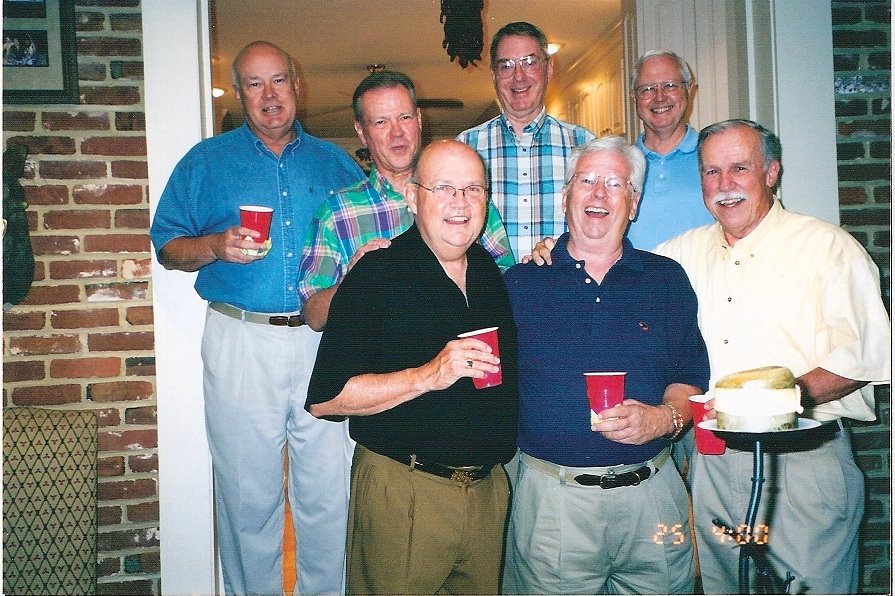
While in high school one Friday morning, I was on the way to the campus and met my friend Ashby. As we passed a refuse heap, we saw a dead rat in it. Talk about the devil in your mind, we both had the idea to take this thing in and put it in a locker. Nobody ever locked a locker in those days unless you had money in it. Most held gym clothes and maybe a book between classes. One of our friends, "F", had always told us that he had been born without the ability to smell. We were going to test this. One of the guys in the picture above is F.
So, the deed was begun. We entered the hall where our lockers were and placed the rat under a pile of dirty gym clothes in F's locker which was not too far from ours. If we had not been somewhat stupid, as most teenage boys are, we would have chosen a more remote spot. We did reckon with whose locker it was but not that it was Friday.
School was out, and we went about our part time jobs, dates, looking for girls, etc. for the weekend. When Monday AM arrived, we didn't give the dead rat a thought until we arrived at school to find that the entire east wing had been closed off until further notice due to something dead in it. After an hour or so, the announcement came that those of us who needed to get into our lockers could go into the east wing. Our home room was in that area, and Ashby and I were about to bust a gut to see what had happened. We ran into the hallway where the lockers were to find F standing in front of his locker holding a pair of gym shorts dripping with maggots. It was true; he could not smell a thing.
Well, the principal went ballistic. He knew that F would not do such a thing to himself, so there had to be other guilty parties. There were about eight of us who had been buddies since kindergarten, so we were immediately excluded from suspicion. There was about a dozen others who were grilled throughout the day, but of course, no one could confess. This was the most fun that we had had since a condom had been affixed to a water fountain tied in the open position. Have you ever seen a condom with about four gallons of water in it? Better yet, how would one remove it without a flood?
We did have a lot of fun in high school. We confessed our rat deed to F after some years, and we all remained friends.
27 March 2006
Al's Neck
A few blogs back, I tried to answer a person's query about what a surgeon thought about before an operation. Later, it occurred to me that I had one experience that was funny to the patient and me too.
I used to play golf occasionally with a local man, who I'll call Al. He was a nice guy and a good golfer. Al was a much better golfer than I was, but we enjoyed the game together. Al's wife was also a good athlete, and I could barely beat her in a tennis match.
Well, one day Al shows up in my office as a patient. He had a good dose of every neurosurgeon's dream case, a classic ruptured disc in his neck. Al's was textbook in every way. Patients such as this always have a great result, and I was pleased that Al would be happy with my treatment. So we put Al in the hospital, ran a confirmatory test, and got him on the surgical schedule.
The evening before he was to have his operation, it occurred to me that neither Al or his wife had ever seen me do anything but play golf or tennis. I always struggled to beat his wife, and I never came close to matching Al's golf scores. I dropped by Al's hospital room as was my routine on pre-op patients. While there, I said, "Al, I want you to know that I do this operation a whole lot better than I play golf". He got a kick out of that, and he got the expected good result.
I used to play golf occasionally with a local man, who I'll call Al. He was a nice guy and a good golfer. Al was a much better golfer than I was, but we enjoyed the game together. Al's wife was also a good athlete, and I could barely beat her in a tennis match.
Well, one day Al shows up in my office as a patient. He had a good dose of every neurosurgeon's dream case, a classic ruptured disc in his neck. Al's was textbook in every way. Patients such as this always have a great result, and I was pleased that Al would be happy with my treatment. So we put Al in the hospital, ran a confirmatory test, and got him on the surgical schedule.
The evening before he was to have his operation, it occurred to me that neither Al or his wife had ever seen me do anything but play golf or tennis. I always struggled to beat his wife, and I never came close to matching Al's golf scores. I dropped by Al's hospital room as was my routine on pre-op patients. While there, I said, "Al, I want you to know that I do this operation a whole lot better than I play golf". He got a kick out of that, and he got the expected good result.
26 March 2006
Comfortable? Uncomfortable?
More and more, it seems that I hear people express whether or not they are "comfortable" doing this or that. Just who guarantees that we are all on this earth to be "comfortable"?
In past years, I told more than one doctor out in the boonies what I thought he should do with a patient before shipping them down the road to me. This usually takes place in the middle of the night with the patient being gravely ill or injured. The doctor is at home, and the nurse from an outlying hospital has called him. He doesn't want to get up, take care that the patient is in as good shape that he can be, before transferring him. This used to be especially true with children who had been injured. Sometimes a blood transfusion begun before transfer can be the difference between life and death in a kid with a broken leg, etc.
Of course, this means that old sleepy head has to rise up, start the transfusion, actually see the patient, etc. Now, we are talking out in the boonies ERs here, not at University City ER. When I used to hear, "I'm not comfortable doing this or that". It didn't make a flying flip to me about the person's comfort. I let them know quickly that their level of comfort was way down my list of things about which to worry. If they had wanted comfort, then selling shoes or something would be right down their alley.
Just a thought on today's ideas put forth by many people, not just doctors.
In past years, I told more than one doctor out in the boonies what I thought he should do with a patient before shipping them down the road to me. This usually takes place in the middle of the night with the patient being gravely ill or injured. The doctor is at home, and the nurse from an outlying hospital has called him. He doesn't want to get up, take care that the patient is in as good shape that he can be, before transferring him. This used to be especially true with children who had been injured. Sometimes a blood transfusion begun before transfer can be the difference between life and death in a kid with a broken leg, etc.
Of course, this means that old sleepy head has to rise up, start the transfusion, actually see the patient, etc. Now, we are talking out in the boonies ERs here, not at University City ER. When I used to hear, "I'm not comfortable doing this or that". It didn't make a flying flip to me about the person's comfort. I let them know quickly that their level of comfort was way down my list of things about which to worry. If they had wanted comfort, then selling shoes or something would be right down their alley.
Just a thought on today's ideas put forth by many people, not just doctors.
24 March 2006
Ashby
One of my lifelong friends was a guy who I'll call Ashby. He was a few months younger, but we grew up from toddlerhood to adulthood being friends. Ashby was a bloody genius in things mechanical, although in his early school years, it was thought he might be "slow". Turns out the kid couldn't read or write because he was half blind. Some glasses cured that problem, and then he took off.
By the time we hit high school, we were into some major adventures. Ashby could hot wire any motor, so we used to take a lot of unauthorized rides in his mother's black Cadillac or his dad's big old Buick. You'd be surprised at how the girls were impressed by those cars.
By the time we got to chemistry in high school, Ashby had a bee in his bonnet to make some gunpowder. The recipe was in the encyclopedia. So many parts sulfur, so many parts potassium nitrate, and so many parts charcoal. It was all available at the drug store. We mixed it up in a dish pan with a wooden spoon. OK. So what do you do with this dish pan of gunpowder? Well. You make a bomb. That's right, a bomb.
Now we weren't gangsters, but how do you know if you've made gunpowder unless it blows up. A man who lived across the street from worked for a metal pipe company, so getting a foot long 3 inch diameter pipe threaded on both ends and caps to screw on it wasn't hard. We took this and drilled a hole in the side near one end for a fuse port. The plan was to fill the pipe with gunpowder, have a cherry bomb inside with the fuse through the small hole, and cap it after compression with a ball bat. Then we would dig a hole, lean the pipe against the side, and place a railroad fusee so that it would burn down, light the fuse and WHAMOO!
OK. Where to dig the hole? Well, that brings up another topic. One that is likely long ago gone. High school fraternities and sororities were popular in the 40s and 50s. Ashby and I belonged to one. Our organization had rented a former night club outside of town that was a great place for parties and meetings. While close to the highway, it sat on the front of a huge wooded area that was totally wild. The terrain was a bit rolling, so we had a natural barrier between us and the "hole".
On a Saturday morning, we walked a few hundred yards into the wood, dug a hole about 2 feet deep, leaned the bomb across in one direction and the fusee in the opposite, lit it, and got the hell out of Dodge and over a small hillock. We had agreed that if there was a dud, we would leave and not return until the next day. Well, no dud. The thing blew up with a loud explosion and shrapnel flew through the trees. As soon as the commotion cleared, we ran over to the detonation site to find a 3 foot diameter hole.
To show how the grace of God protects fools, about two years later, a young highschooler in Knoxvile, TN blew himself in half making a pipe bomb in his parents' garage. He was packing the powder with a metal rod which sparked off a pipe edge. Glad we used a baseball bat of wood.
By the time we hit high school, we were into some major adventures. Ashby could hot wire any motor, so we used to take a lot of unauthorized rides in his mother's black Cadillac or his dad's big old Buick. You'd be surprised at how the girls were impressed by those cars.
By the time we got to chemistry in high school, Ashby had a bee in his bonnet to make some gunpowder. The recipe was in the encyclopedia. So many parts sulfur, so many parts potassium nitrate, and so many parts charcoal. It was all available at the drug store. We mixed it up in a dish pan with a wooden spoon. OK. So what do you do with this dish pan of gunpowder? Well. You make a bomb. That's right, a bomb.
Now we weren't gangsters, but how do you know if you've made gunpowder unless it blows up. A man who lived across the street from worked for a metal pipe company, so getting a foot long 3 inch diameter pipe threaded on both ends and caps to screw on it wasn't hard. We took this and drilled a hole in the side near one end for a fuse port. The plan was to fill the pipe with gunpowder, have a cherry bomb inside with the fuse through the small hole, and cap it after compression with a ball bat. Then we would dig a hole, lean the pipe against the side, and place a railroad fusee so that it would burn down, light the fuse and WHAMOO!
OK. Where to dig the hole? Well, that brings up another topic. One that is likely long ago gone. High school fraternities and sororities were popular in the 40s and 50s. Ashby and I belonged to one. Our organization had rented a former night club outside of town that was a great place for parties and meetings. While close to the highway, it sat on the front of a huge wooded area that was totally wild. The terrain was a bit rolling, so we had a natural barrier between us and the "hole".
On a Saturday morning, we walked a few hundred yards into the wood, dug a hole about 2 feet deep, leaned the bomb across in one direction and the fusee in the opposite, lit it, and got the hell out of Dodge and over a small hillock. We had agreed that if there was a dud, we would leave and not return until the next day. Well, no dud. The thing blew up with a loud explosion and shrapnel flew through the trees. As soon as the commotion cleared, we ran over to the detonation site to find a 3 foot diameter hole.
To show how the grace of God protects fools, about two years later, a young highschooler in Knoxvile, TN blew himself in half making a pipe bomb in his parents' garage. He was packing the powder with a metal rod which sparked off a pipe edge. Glad we used a baseball bat of wood.
Gigli Gets the Needle
Yesterday, I went over to the hospital for an injection of cortisone into my right shoulder joint. This was set up after I saw the orthopedist a week before and found that I had degenerative arthritis (known as gray hair of the skeletal system) in both shoulders. He knew that I was a physician, and we talked about the procedure a bit.
So, I show up and go to the ER where a c-arm fluroscope is set up. The doc shows up, preps my shoulder, and under fluroscopic control places a needle into the joint and delivers the medicine. I am out of there is 5 minutes and go home.
So? Well, at no time was I asked to sign any consent or hear a litany of horrors as to what might happen to me. If I had being doing the same procedure in the USA, I would have had forms signed by the patient saying that they understood the possibilities of infection, paralysis, and death. Even with all that, there would still be a lawyer willing to sue because he would know that the insurance company would settle. If I refused to settle, then the company would have dropped me the next year.
Just not quite as litigious over here. A doc can get into trouble, but he has to be almost criminal in his actions. In medical school, a lawyer taught us jurisprudence. The idea was that docs are humans, and humans make mistakes. You would never be sued for a mistake. Nowadays, if a doc takes on a patient, there is an implied contract that the doc will make the patient well.
That's a bunch of horse feathers!
So, I show up and go to the ER where a c-arm fluroscope is set up. The doc shows up, preps my shoulder, and under fluroscopic control places a needle into the joint and delivers the medicine. I am out of there is 5 minutes and go home.
So? Well, at no time was I asked to sign any consent or hear a litany of horrors as to what might happen to me. If I had being doing the same procedure in the USA, I would have had forms signed by the patient saying that they understood the possibilities of infection, paralysis, and death. Even with all that, there would still be a lawyer willing to sue because he would know that the insurance company would settle. If I refused to settle, then the company would have dropped me the next year.
Just not quite as litigious over here. A doc can get into trouble, but he has to be almost criminal in his actions. In medical school, a lawyer taught us jurisprudence. The idea was that docs are humans, and humans make mistakes. You would never be sued for a mistake. Nowadays, if a doc takes on a patient, there is an implied contract that the doc will make the patient well.
That's a bunch of horse feathers!
21 March 2006
Prayer Meeting
My medical school ran on the quarter system. Every eleven weeks, a new quarter began. We began to take surgery courses in the ninth quarter and would have class room and surgical clinics until we graduated. Surgery was interesting, and because we had some good teachers, we enjoyed it.
EXCEPT FOR:
Prayer meeting. This was a gathering of all surgical students, ninth through twelfth quarters held in a large auditorium at one PM each Friday. Each class tried to sit together, and all tried to look as inconspicuous as possible. The later quarter students were especially nervous because they were expected to know a lot more than the ninth or tenth quarter classes. It was a bitch of the first water!!
Why? Because it was run by the chief resident in surgery and the grand doo dah professor of surgery. Now, the professor was benign, although he could be sarcastic (a quality that I had not learned to appreciate yet). The chief resident, who later became a friend, struck terror into us all. The chief resident was a fifth year general surgery resident but also on the surgical staff as a paid member. He was selected by the teaching staff each year, and as chief he was responsible for scheduling other residents, teaching, problem solving, and everything else that no one on the regular staff wished to do. His perks were prestige, some salary, and the fact that he got the pick of any case that hit the door, no matter what. I knew only three chief residents, but they were all superior physicians and highly successful in their later careers. All general surgery residents would have gladly traded a gonad for the job.
Our chief resident was "Big Lou". He went on to become a renown transplant surgeon. He once told me that he always went to bed with a surgical journal. " you learn something, and it is a great sleeping aid." He was an imposing figure of a man, slicker than greased owl poop, and always right in his judgments (at least it seemed that way). He and the professor ran the prayer meeting and in a perverse way were proud of the name we had given the "conference". I do not remember how the roll call was kept, but I do know that it was not a class to cut. Unless you were hospitalized, you were there!
The format was this: A patient from the wards was brought in and presented to the audience with history, physical findings, and lab reports. The diagnosis was not usually given but ranged from the exotic to the everyday ailments that affect people. At that point one or more students were asked to come to the stage. That was white knuckle time. Those students would be queried on anything remotely to do with the case in front of their peers and judged by Big Lou and the professor. If a mistake was made or ignorance professed, results ranged from a mild rebuke and the answer, to a "WHAT, YOU DON'T KNOW!!!!", and the thought out loud that maybe another profession was in your future.
I only remember one time that I was in the hot seat. Big Lou and the professor quizzed me on a lady's varicose veins, and I got away like a bandit in a cold sweat. I am sure there were other times, but repression is a powerful mental mechanism. I did see a few compatriots raked back and forth though, and until graduation day, Prayer Meeting was always on our minds.
One more thought on Big Lou. He wasn't a bully, but he believed that tension was a great adjunct to learning. In our last quarter, we were each paired with a surgical resident, including the chief resident. The most timid and introverted man in our class got Big Lou. We wondered if he would survive. He was a good student but came across as scared of his shadow. Well, he realized that it was sink or swim time, so he gave Big Lou everything he received from him right back. Both of them survived and became friends.
EXCEPT FOR:
Prayer meeting. This was a gathering of all surgical students, ninth through twelfth quarters held in a large auditorium at one PM each Friday. Each class tried to sit together, and all tried to look as inconspicuous as possible. The later quarter students were especially nervous because they were expected to know a lot more than the ninth or tenth quarter classes. It was a bitch of the first water!!
Why? Because it was run by the chief resident in surgery and the grand doo dah professor of surgery. Now, the professor was benign, although he could be sarcastic (a quality that I had not learned to appreciate yet). The chief resident, who later became a friend, struck terror into us all. The chief resident was a fifth year general surgery resident but also on the surgical staff as a paid member. He was selected by the teaching staff each year, and as chief he was responsible for scheduling other residents, teaching, problem solving, and everything else that no one on the regular staff wished to do. His perks were prestige, some salary, and the fact that he got the pick of any case that hit the door, no matter what. I knew only three chief residents, but they were all superior physicians and highly successful in their later careers. All general surgery residents would have gladly traded a gonad for the job.
Our chief resident was "Big Lou". He went on to become a renown transplant surgeon. He once told me that he always went to bed with a surgical journal. " you learn something, and it is a great sleeping aid." He was an imposing figure of a man, slicker than greased owl poop, and always right in his judgments (at least it seemed that way). He and the professor ran the prayer meeting and in a perverse way were proud of the name we had given the "conference". I do not remember how the roll call was kept, but I do know that it was not a class to cut. Unless you were hospitalized, you were there!
The format was this: A patient from the wards was brought in and presented to the audience with history, physical findings, and lab reports. The diagnosis was not usually given but ranged from the exotic to the everyday ailments that affect people. At that point one or more students were asked to come to the stage. That was white knuckle time. Those students would be queried on anything remotely to do with the case in front of their peers and judged by Big Lou and the professor. If a mistake was made or ignorance professed, results ranged from a mild rebuke and the answer, to a "WHAT, YOU DON'T KNOW!!!!", and the thought out loud that maybe another profession was in your future.
I only remember one time that I was in the hot seat. Big Lou and the professor quizzed me on a lady's varicose veins, and I got away like a bandit in a cold sweat. I am sure there were other times, but repression is a powerful mental mechanism. I did see a few compatriots raked back and forth though, and until graduation day, Prayer Meeting was always on our minds.
One more thought on Big Lou. He wasn't a bully, but he believed that tension was a great adjunct to learning. In our last quarter, we were each paired with a surgical resident, including the chief resident. The most timid and introverted man in our class got Big Lou. We wondered if he would survive. He was a good student but came across as scared of his shadow. Well, he realized that it was sink or swim time, so he gave Big Lou everything he received from him right back. Both of them survived and became friends.
My Funeral Home career
When I was a junior in high school, I got a job at a funeral home(a friend was an apprentice funeral director, so I guess I "networked" it). I knew that I wanted to go into medicine, so I was interested in the anatomy, and it is certainly a good way to learn how to deal with folks at a bad time, as well as, meet the public. I worked after school, nights, and weekends, and it was a great job. I slept there, and since the phone bell was right under the head of my bed, I became conditioned to waking on the first ring. That came in handy later.
One of the two owners was the county coroner, and I enjoyed going on his cases with him. In those days, there were no EMTs, so funeral homes ran an emergency ambulance service. There was no training as today. We had a big red standard shift Cadillac accident ambulance with more lights and sirens than you could count. That scoundrel would go 70 MPH in second gear. I only drove it when the boss told me to take it out for a warmup spin, but at seventeen, that was a thrill. Our place had been in business for 100 years, so we buried all the aristocrats in town.
One coroner call will remain in my memory fore life. We were called by the police to a home that I had passed many times on the main street leading into the business district. As we entered the front door, it was obvious that all the house except a large kitchen was filled with lumber stacked almost to the ceiling. In the kitchen was a black man who was employed by the owner. He had reported the case to the police after finding his employer dead. It turns out that this employer owned a lot of property in the poorer section of town and lived off the rents. He didn't have rental payment problems because if a renter failed to pay, the black man just went by and took the front door off the house until payment was received. The dead man had lived alone with his mother in the house until she died. The black man showed us a brand new Lincoln in the garage that had never been driven except home from the dealer in town. It had been covered totally with cosmoline, that grease with which that weapons shipped at sea used to be covered. It was about three years old.
The deceased man was no doubt psychotic, but he did rig up an ingenious way to kill himself. In a corner of the kitchen, there was a wooden box built flush to the walls. It was about 4 by 4 by 8 feet in dimensions. The black man said he had helped the man build it, and they had caulked it like a boat. It was air tight when the lid was closed too. Now this dead man was really big (so big that we had to get a specially built coffin from a supplier to fit him). He was lying in the box clad in a nice bathrobe, quite dead, and quite cherry red. His skin and even the whites of his eyes were bright red. He was peaceful in repose, as if no struggle had occurred. There were about six carbon dioxide fire extinguishers, all discharged, at his feet and sides. He had done a good job of asphyxiating himself.
We took him back to the funeral home, embalmed him, and got him situated in the new coffin. He had two nephews as survivors. It was a small funeral.
One of the two owners was the county coroner, and I enjoyed going on his cases with him. In those days, there were no EMTs, so funeral homes ran an emergency ambulance service. There was no training as today. We had a big red standard shift Cadillac accident ambulance with more lights and sirens than you could count. That scoundrel would go 70 MPH in second gear. I only drove it when the boss told me to take it out for a warmup spin, but at seventeen, that was a thrill. Our place had been in business for 100 years, so we buried all the aristocrats in town.
One coroner call will remain in my memory fore life. We were called by the police to a home that I had passed many times on the main street leading into the business district. As we entered the front door, it was obvious that all the house except a large kitchen was filled with lumber stacked almost to the ceiling. In the kitchen was a black man who was employed by the owner. He had reported the case to the police after finding his employer dead. It turns out that this employer owned a lot of property in the poorer section of town and lived off the rents. He didn't have rental payment problems because if a renter failed to pay, the black man just went by and took the front door off the house until payment was received. The dead man had lived alone with his mother in the house until she died. The black man showed us a brand new Lincoln in the garage that had never been driven except home from the dealer in town. It had been covered totally with cosmoline, that grease with which that weapons shipped at sea used to be covered. It was about three years old.
The deceased man was no doubt psychotic, but he did rig up an ingenious way to kill himself. In a corner of the kitchen, there was a wooden box built flush to the walls. It was about 4 by 4 by 8 feet in dimensions. The black man said he had helped the man build it, and they had caulked it like a boat. It was air tight when the lid was closed too. Now this dead man was really big (so big that we had to get a specially built coffin from a supplier to fit him). He was lying in the box clad in a nice bathrobe, quite dead, and quite cherry red. His skin and even the whites of his eyes were bright red. He was peaceful in repose, as if no struggle had occurred. There were about six carbon dioxide fire extinguishers, all discharged, at his feet and sides. He had done a good job of asphyxiating himself.
We took him back to the funeral home, embalmed him, and got him situated in the new coffin. He had two nephews as survivors. It was a small funeral.
20 March 2006
This Surgeon's Thoughts
I got an email from a friend today with the following quote about a question that another friend had asked him.
In casual conversation ** mentioned that he was always
curious about what a surgeon thought about before an operation. Was it
just the body of the day on the table? Was it a known person who had been
researched ahead of time? Etc., etc. I can't really relate his thoughts
but he is kind of a deep thinker on things like this but would be afraid
to ask questions of a real surgeon because ** would think of them as
being so far above him.
Well, I can only answer for myself. First, a surgeon puts his pants on one leg at a time just like everyone else. So, lets just forget the caste system. If you are willing to let some person flay you open with a scalpel without questions, you aren't the sharpest tool in the shed.
With few exceptions, I never was a personal friend of a surgical patient under my care. I did, on occasion, have occasion to operate on friends or children of friends. It was usually an unpleasant emergency situation and was an added stress. I did do several operations on friends with serious and yet non-traumatic conditions, where life could be lost or, the person left incapacitated in some way. Again, these were stressful above the norm.
With an "average" operation, I did not dwell on the procedure or patient to excess. Depending on the procedure's complexity, the preparation mentally varied. I was never a "ghost" surgeon, so I always knew the patient's background from a health standpoint, considered the complications, and discussed this, as well as the risk/benefit ratio, with them. In the case of children and those without good faculties, this was done with some responsible party. Of course, with emegencies, there was often no choice. I have met a number of parents and relatives for the first time after the surgery was done, and the patient had been treated in an emergency.
With complex procedures such as intracranial and intraspinal tumors and vascular lesions, I used to try and walk myself through the operation the day before. For some years, I was a runner, and many an operation has been rehearsed in my mind as I did my morning run. It was always good to plan for contingencies. The old saying that no one likes surprises in an operating room is true. They are usually not pleasant. For many of my operating years, I had a scrub nurse that was always with me. We could discuss in detail, if needed, the procedure beforehand. That was always helpful too.
So, in a nutshell, that is it. Anyone with questions can leave me a comment, and I'll try to answer.
In casual conversation ** mentioned that he was always
curious about what a surgeon thought about before an operation. Was it
just the body of the day on the table? Was it a known person who had been
researched ahead of time? Etc., etc. I can't really relate his thoughts
but he is kind of a deep thinker on things like this but would be afraid
to ask questions of a real surgeon because ** would think of them as
being so far above him.
Well, I can only answer for myself. First, a surgeon puts his pants on one leg at a time just like everyone else. So, lets just forget the caste system. If you are willing to let some person flay you open with a scalpel without questions, you aren't the sharpest tool in the shed.
With few exceptions, I never was a personal friend of a surgical patient under my care. I did, on occasion, have occasion to operate on friends or children of friends. It was usually an unpleasant emergency situation and was an added stress. I did do several operations on friends with serious and yet non-traumatic conditions, where life could be lost or, the person left incapacitated in some way. Again, these were stressful above the norm.
With an "average" operation, I did not dwell on the procedure or patient to excess. Depending on the procedure's complexity, the preparation mentally varied. I was never a "ghost" surgeon, so I always knew the patient's background from a health standpoint, considered the complications, and discussed this, as well as the risk/benefit ratio, with them. In the case of children and those without good faculties, this was done with some responsible party. Of course, with emegencies, there was often no choice. I have met a number of parents and relatives for the first time after the surgery was done, and the patient had been treated in an emergency.
With complex procedures such as intracranial and intraspinal tumors and vascular lesions, I used to try and walk myself through the operation the day before. For some years, I was a runner, and many an operation has been rehearsed in my mind as I did my morning run. It was always good to plan for contingencies. The old saying that no one likes surprises in an operating room is true. They are usually not pleasant. For many of my operating years, I had a scrub nurse that was always with me. We could discuss in detail, if needed, the procedure beforehand. That was always helpful too.
So, in a nutshell, that is it. Anyone with questions can leave me a comment, and I'll try to answer.
16 March 2006
The Irish Really Are Crazy
Both the spouse and I have Irish roots. The Vances come from Belfast, and the McDarbys came from County Clare. I don't let that bother me at all, but Barbara gets a big bee in her bonnet every year about March 17th, St. Patrick's Day. This year, she got the urge to corn a beef, so we could have corned beef and cabbage to celebrate. Now, if there is commercially available corned beef in CH, I am not aware of it and likely wouldn't pay the price they would ask for it. So, for some days now, we have had a piece of beef under a solution in a dish in the refrigerator "corning". In the process of searching the internet for instruction on corning, we did learn something about it as a preservation method.
Still, I don't think that our kitchen is going to become a corning center anytime soon. I think the Swiss have had some education too. When Barbara went to a drug store to buy some Saltpeter (potassium nitrate), she got queried on what she was going to do with it. No surprise since it is also an ingredient of gun powder. I suppose that she doesn't fit the profile of a terrorist (little that they know) because she did get some, and it along with salt and other ingredients are perking away on that beef for the third day. Hope it doesn't blow up!
Irish soda bread has been made, and cabbage and potatoes are on hand. I just bought a bottle of Irish Whiskey, and sometime today, we will dive into a St. Patrick's Day feast interspersed with shots of the Irish Dew and some Guiness Stout. Think our house won't sleep well this night?
Still, I don't think that our kitchen is going to become a corning center anytime soon. I think the Swiss have had some education too. When Barbara went to a drug store to buy some Saltpeter (potassium nitrate), she got queried on what she was going to do with it. No surprise since it is also an ingredient of gun powder. I suppose that she doesn't fit the profile of a terrorist (little that they know) because she did get some, and it along with salt and other ingredients are perking away on that beef for the third day. Hope it doesn't blow up!
Irish soda bread has been made, and cabbage and potatoes are on hand. I just bought a bottle of Irish Whiskey, and sometime today, we will dive into a St. Patrick's Day feast interspersed with shots of the Irish Dew and some Guiness Stout. Think our house won't sleep well this night?
They're Going to do WHAT with the Swiss Constitution?
Plans are afoot for the Swiss government to ship the Bundesbrief (the original charter of the Swiss Confederation of 1291) to Philadelphia as a loan to a museum for an exhibit called "Swiss Roots". This document can be compared to the USA's Declaration Of Independence and usually resides in a glass enclosure in the village of Schwyz in the Kanton of Schwyz, one of the original signatories of the Bundesbrief.
Some members of the far right SVP party formed a foundation recently and asked the government to accept a million Swiss francs and sell them the document. This was to thwart any such plans for its travel. Of course, the federal authorities quickly said that the Bundesbrief was not for sale at any price. Now the papers are full of opinions about whether this move is good or not. One school says that people who see it in Philadelphia will want to come to CH as tourists. Another group says that tourists already here will miss seeing it while it is in the USA.
I don't know if the Declaration of Independence has ever traveled outside the USA, but I do remember The Freedom Train which carried it around the USA for many months. Even that would not likely be done now because of all the kooks that would love to hold it hostage. I think the Bundesbrief should stay put.
Some members of the far right SVP party formed a foundation recently and asked the government to accept a million Swiss francs and sell them the document. This was to thwart any such plans for its travel. Of course, the federal authorities quickly said that the Bundesbrief was not for sale at any price. Now the papers are full of opinions about whether this move is good or not. One school says that people who see it in Philadelphia will want to come to CH as tourists. Another group says that tourists already here will miss seeing it while it is in the USA.
I don't know if the Declaration of Independence has ever traveled outside the USA, but I do remember The Freedom Train which carried it around the USA for many months. Even that would not likely be done now because of all the kooks that would love to hold it hostage. I think the Bundesbrief should stay put.
14 March 2006
A Trip to the Faulhorn
How about a 4 hour hike up to a hotel where the only way in or out is by foot or helicopter? That idea sounded intriguing to me when I first heard of this place years ago. Eventually, I made it up there three times.
The Faulhorn Hotel is a far cry from the usual 5 star Swiss hotel, but it is an experience. When you get there, you are about 8000 feet above sea level and looking across a valley directly at the Jungfrau, Moench, and Eiger Nordwand. The view is free for as long as the light lasts and you sit on the terrace. There is a separate building that houses the kitchen and dining area. Then the main hotel building houses two large rooms and quarters for the employees and family that run the place.
You say, "Only a two room hotel?" Well, that is right. However, each room sleeps about 40 persons! Whoa Boy!! Who would sleep in a room with 39 other people? The answer is that so many that you have to call for a reservation. Since the hotel is only open about three months a year, a lot of hikers want to get there in a short time. These rooms are called "Matratzenlagers" or mattress areas. Picture a double bunk that has been widened to hold 40 beds with stairs at each end and then put two of these across from each other with an aisle between them. There you have a Matratzenlager. Each person has an individual mattress and blanket with a pillow running the length of the bed. The whole room is spotless and clean with windows high near the ceilings. All shoes are deposited outside in a cloakroom area, so only sock feet ever touch the floors. The night and breakfast will cost about 25% of what a regular room in a hotel costs.
The dining room serves as a communal place to eat, drink, and entertain one's self for the evening. The food is not fancy, but after a 4 hour walk up (only the last few minutes are really tough), it tastes mighty good. Then people talk, play cards, or read. No one has trouble sleeping either. On my first visit there was a howling wind most of the night, but insomnia was not a problem. If you must heed nature's call in the night, it can be done in a communal bathroom with running cold water. On the first visit, one had to go outside (I did not) to use the facilities. On the later visits several years ago, they had upgraded the bathroom beautifully.
The hike can begin either in Grindelwald or Schynige Platte. My visits have always begun at First, reached from Grindelwald by cable car, and with the return by way of Schynige Platte and the rail down to Interlaken. This means about 4 hours up and 5 hours across the next day to Schynige Platte and home. The walk both ways is scenic, and only about 40 minutes is steeply up to the hotel. After arrival, one checks in with the lady in the restaurant, and she will assign a bed to you.
On one visit, we were treated to a magnificent thunderstorm the rolled across from us obscuring the view for some minutes. One should not miss the sunrises and sunsets from here. The tips of the mountains look like golden spikes at both events. By 9 or 10 PM, all are ready to pile it in for a night. Sleeping with 40 people can be a hoot. There are the usual sounds, snores and otherwise, but sleep comes quickly. Once, as we lay in the dark, this Indian guy who was a bit drunk started telling jokes to his friends in dialect with a Hindi accent. The whole room was in stitches even though we couldn't understand what he was saying, but this guy had a head the next day, I am sure.
Most people are up early since the sunrise is a treat. Breakfast is the usual milchkaffee or chocolate, bread, rolls, jam, butter, and cheese. Then the new day's hike begins. Ours has always been over to Schynige Platte, where a good lunch can be had on the terrace before a ride down on a cog rail to Wilderswil where the train to home begins. I enjoy this hike every few years, but it is always good to get home to a shower and my own bed.
The Faulhorn Hotel is a far cry from the usual 5 star Swiss hotel, but it is an experience. When you get there, you are about 8000 feet above sea level and looking across a valley directly at the Jungfrau, Moench, and Eiger Nordwand. The view is free for as long as the light lasts and you sit on the terrace. There is a separate building that houses the kitchen and dining area. Then the main hotel building houses two large rooms and quarters for the employees and family that run the place.
You say, "Only a two room hotel?" Well, that is right. However, each room sleeps about 40 persons! Whoa Boy!! Who would sleep in a room with 39 other people? The answer is that so many that you have to call for a reservation. Since the hotel is only open about three months a year, a lot of hikers want to get there in a short time. These rooms are called "Matratzenlagers" or mattress areas. Picture a double bunk that has been widened to hold 40 beds with stairs at each end and then put two of these across from each other with an aisle between them. There you have a Matratzenlager. Each person has an individual mattress and blanket with a pillow running the length of the bed. The whole room is spotless and clean with windows high near the ceilings. All shoes are deposited outside in a cloakroom area, so only sock feet ever touch the floors. The night and breakfast will cost about 25% of what a regular room in a hotel costs.
The dining room serves as a communal place to eat, drink, and entertain one's self for the evening. The food is not fancy, but after a 4 hour walk up (only the last few minutes are really tough), it tastes mighty good. Then people talk, play cards, or read. No one has trouble sleeping either. On my first visit there was a howling wind most of the night, but insomnia was not a problem. If you must heed nature's call in the night, it can be done in a communal bathroom with running cold water. On the first visit, one had to go outside (I did not) to use the facilities. On the later visits several years ago, they had upgraded the bathroom beautifully.
The hike can begin either in Grindelwald or Schynige Platte. My visits have always begun at First, reached from Grindelwald by cable car, and with the return by way of Schynige Platte and the rail down to Interlaken. This means about 4 hours up and 5 hours across the next day to Schynige Platte and home. The walk both ways is scenic, and only about 40 minutes is steeply up to the hotel. After arrival, one checks in with the lady in the restaurant, and she will assign a bed to you.
On one visit, we were treated to a magnificent thunderstorm the rolled across from us obscuring the view for some minutes. One should not miss the sunrises and sunsets from here. The tips of the mountains look like golden spikes at both events. By 9 or 10 PM, all are ready to pile it in for a night. Sleeping with 40 people can be a hoot. There are the usual sounds, snores and otherwise, but sleep comes quickly. Once, as we lay in the dark, this Indian guy who was a bit drunk started telling jokes to his friends in dialect with a Hindi accent. The whole room was in stitches even though we couldn't understand what he was saying, but this guy had a head the next day, I am sure.
Most people are up early since the sunrise is a treat. Breakfast is the usual milchkaffee or chocolate, bread, rolls, jam, butter, and cheese. Then the new day's hike begins. Ours has always been over to Schynige Platte, where a good lunch can be had on the terrace before a ride down on a cog rail to Wilderswil where the train to home begins. I enjoy this hike every few years, but it is always good to get home to a shower and my own bed.
09 March 2006
A Miami Beach Wannabe
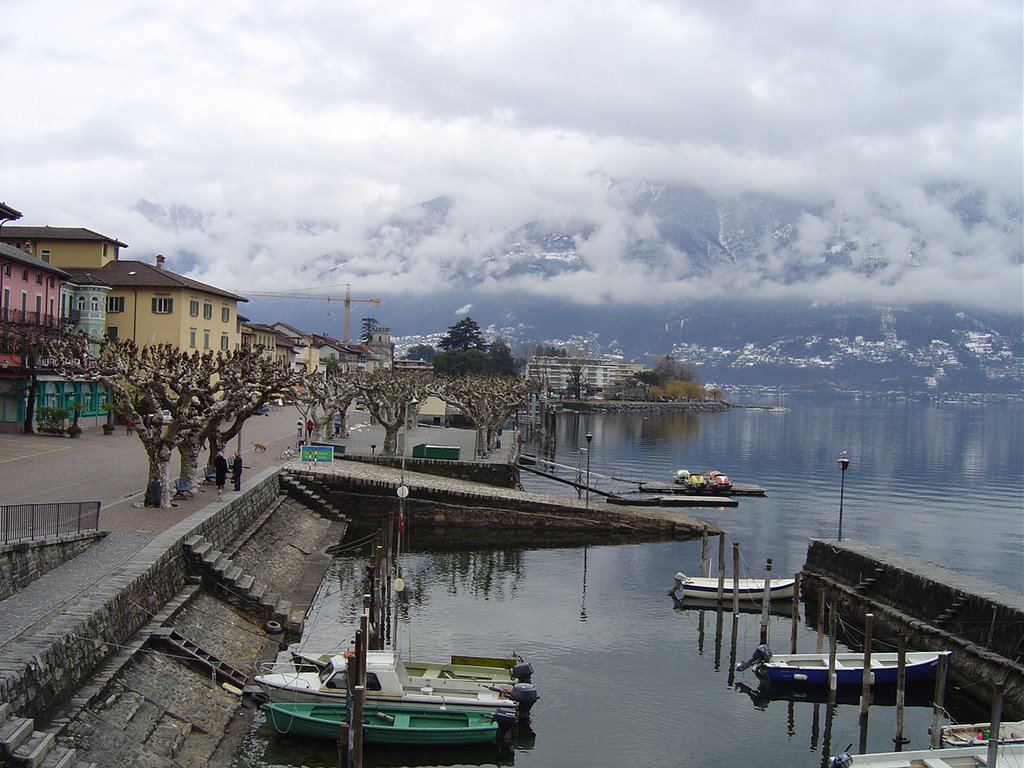 Our day to go to Ascona was another gray and wet one. We were to leave soon, so this was it. A short ride on the bus that stops across the street from the train station got us to the post office stop in Ascona. From there we spent an hour or so wandering the neighborhoods and wound up on a path that parallels the lake shore. It was definitely the high rent district Some of the hotels along the way reminded us of Miami Beach with colors and architecture. There were definitely no crowds! We then came into the main harbor which would be pretty with the trees in foliage, but this day looked awfully bleak.
We took a break to get our email in a small bar. Internet spots abound in Locarno and a few were in Ascona. The Locarno tourist office had given us a sheet of internet cafes earlier in the week. For 8 CHF, you get 40 minutes or lesser times for fewer CHF. Anyway, I ordered a beer and Barbara needed something warm, so she ordered an Irish Coffee. Now ordinarily she is a cheap date, but the Irish Coffee was 11.50 CHF. That's closing in on 9 US$ at today's rate. Guess Ascona is used to the high rollers, just like Miami Beach.
The net worth remained intact though, and after a stroll along fine shops mostly closed for the season, we were back to Locarno.
Subscribe to:
Posts (Atom)