Today, I read in the Atlanta newspaper that another instance of child abuse has occurred in an Atlanta area school. This damnable deed took place at the hands of a fourth grade teacher right in a public place too.
It seems the perpetrator advised the class that while on a field trip to The Atlanta History Center, if anyone's behavior was out of line, they would be tied up. That was her first big mistake. Issue a challenge like that to a bunch of fourth graders, and you will have them lining up to get tied. Well anyway, it wasn't long into the trip when this kid leaves his partner and goes to the back of the line to speak with a friend (no doubt about some cultural tidbit that he had picked up). The teacher, true to her word, lashes a jump rope to his wrist. As is wont to be, there were soon four other boys soon tied in tandem with this first kid.
The beast in charge here later ties the rope to her pant's belt loop (not a good idea if five boys decide to run for it, but she did it). After one kid complained of his wrist being uncomfortable, they were released. One of the boys casually mentioned to his mother at the dinner table some days later that he had been tied up by the teacher. Well, that will always get your attention. After all, how many teachers overtly are into bondage/submission activities? At that point, it really hit the fan. The teacher is now into counseling, and other unspecified remedies are likely. Of course the kid is scarred for life, has nightmares, suffers in intersocial activities, would have loss of consortorium if he was old enough, and in general is just a mess. He would be suicidal if it were not for the fact that he and the four others are legendary heroes in their class.
Well, this tale of disgrace reminds me of my earlier school days with Mr. H. I was in the seventh grade, not the fourth, when Mr. H taught us USA Geography. Part of our instruction was to learn the USA states with their capitols and their spellings. Mr. H made this into a game where we turned down a person next to us if they misspelled or otherwise did not know a state or capitol. We enjoyed this. Mr. H (the ogre that he was) also said if we missed a question, we would have to stay in detention to study what we had missed. Nobody wanted that. He did give another choice to the boys in the class. The boys could skip detention if they chose to take licks (with a paddle, not a tongue-don't get all prurient on me). Mr. H was a football coach and fit the physical bill for that, so we knew that his arm wouldn't give out.
Of course, Mr. H violated a feminist rule by not allowing the girls a choice of licks, but that was another day and time. Some of the more hardy girls wanted this option, but it was denied them. As I recall, no boy ever opted not to take licks in lieu of detention. We all survived and revered Mr. H as a good guy. We also learned the states and capitols.
Back to the present, is it any wonder that we have twelve year old boys raping ten year old girls? After all, no one would ever really punish them, would they? If kids do not learn the unpleasant things associated with failing to obey the rules, won't they do just as they please without a thought of the consequences?
This is an admittedly old fart attitude. I guess that I am just not young enough to be as smart as some.
21 December 2006


14 December 2006
You Never Know
Just outside of Luzern is a community called Emmenbruecke. It makes the headines every so often when it denies Swiss citizenship to Turkish or Eastern Bloc people who have sometimes been here for two or even three generations. A lot of Swiss are horified at this discrimination. At one time there was a move about to eliminate the rights of communities to be the ones that grant citizenship because of some of their actions.
So today in the newspaper, I wasn't a bit surprised to read that a Christmas musical play was taking place at a local school where most of the fourth graders are either catholic or protestant. What did blow me away was the interviews thay had with the two kids who are cast as Mary and Joseph. Each child is a Muslim! They are proud to have a leading part in the play, even though they readily admit that Christmas means nothing more than a holiday to them.
How about that for intergration? Wonder if a Christian could ever play Mohammad?
So today in the newspaper, I wasn't a bit surprised to read that a Christmas musical play was taking place at a local school where most of the fourth graders are either catholic or protestant. What did blow me away was the interviews thay had with the two kids who are cast as Mary and Joseph. Each child is a Muslim! They are proud to have a leading part in the play, even though they readily admit that Christmas means nothing more than a holiday to them.
How about that for intergration? Wonder if a Christian could ever play Mohammad?
10 December 2006
Only in the Laboratory
Now, I can wonder if I haven't heard it all. In the Sunday new York Times Magazine, I ran into an article about E. coli Wipes. E. coli is big time news these days. We all have read and heard about spinach, and the mess that Taco Bell got into with their scallions. People can get as sick as a blue ox when they ingest certain types of E. coli. Some may even die. E. coli is everywhere in our environment.
These two scientists at Cornell University have developed a wipe made of a coating that when dipped in another solution shows the prescence of some bacteria. So far the number of infectious agents that can be identified is limited, but one strain of E. coli does show up. They also are working on a "non-dip" system to make use of the wipes easier.
This sounds good, BUT I have a few reservations. Unless you are in some sort of clean room like that found in some hospitals, bacteria and virus abound. Even the clean rooms are not sterile. Can you imagine a wipe of a car door handle, a set of keys, an armrest on a bus or airplane? Pathogens are all around us, and our bodies are invaded numerous times a day. Brushing your teeth has been shown to cause bacteria to enter the bloodstream. The possibilities are endless, but in the majority of invasions the body uses its natural defenses to rid itself of these agents.
Could this turn the population into a mass of Lady Macbeths? Can you imagine the gallons of hand sanitizer people will carry around? There would be long lines at sinks for handwashing (still the single most effective disease prevetion method of all). How about running a wipe over your sweetie's lips before a kiss or holding hands? No one would venture into a public place since a wipe would prove it to be a pesthole. Airline travel would be for only those willing to get into special suits that would exclude all contamination (airplanes are still one of the truest forms of pestilence delivering agents in this world). Of course, any idiot that could pound sand would be wiping down all the scallions in taco Bell. These are just a few examples.
This could be one of those discoveries that is best relegated to the trash heap of history. Just a thought.
These two scientists at Cornell University have developed a wipe made of a coating that when dipped in another solution shows the prescence of some bacteria. So far the number of infectious agents that can be identified is limited, but one strain of E. coli does show up. They also are working on a "non-dip" system to make use of the wipes easier.
This sounds good, BUT I have a few reservations. Unless you are in some sort of clean room like that found in some hospitals, bacteria and virus abound. Even the clean rooms are not sterile. Can you imagine a wipe of a car door handle, a set of keys, an armrest on a bus or airplane? Pathogens are all around us, and our bodies are invaded numerous times a day. Brushing your teeth has been shown to cause bacteria to enter the bloodstream. The possibilities are endless, but in the majority of invasions the body uses its natural defenses to rid itself of these agents.
Could this turn the population into a mass of Lady Macbeths? Can you imagine the gallons of hand sanitizer people will carry around? There would be long lines at sinks for handwashing (still the single most effective disease prevetion method of all). How about running a wipe over your sweetie's lips before a kiss or holding hands? No one would venture into a public place since a wipe would prove it to be a pesthole. Airline travel would be for only those willing to get into special suits that would exclude all contamination (airplanes are still one of the truest forms of pestilence delivering agents in this world). Of course, any idiot that could pound sand would be wiping down all the scallions in taco Bell. These are just a few examples.
This could be one of those discoveries that is best relegated to the trash heap of history. Just a thought.
08 December 2006
RJ and the Death Celebration
In the old days, while I was a pre- medical undergraduate student, I went to the University of Tennessee in Knoxville. After being admitted to the medical school, I moved on to the medical units in Memphis.
To get to Memphis there were several hoops through which one had to jump. Grades, MCAT scores, etc. were important. Not the least important was to get by RJ and her physics course of three quarters. There seemed to be no way to get to Memphis without decent grades in physics. I had a great high school physics teacher, so I didn't worry a lot. That is, I didn't worry a lot until I got the scoop on RJ's course.
This lady was an old maid, ugly as homemade sin, smoked like a chimney, and hated men, especially those men aspiring to become doctors. I might mention that in those days, a teacher smoking in class was acceptable. RJ had a penchant for reminding her classes of pre-med students that they weren't going to get to Memphis without getting by her. She likely would have been a good teacher if she had not had these hangups. Her students were in her class always. No one would have cut her class if they had been half dead.
Her quizzes were always unannounced and took on a bizzare turn. She would enter the room, write a question or questions on the board, and then light up a Lucky Strike. When she put it out, the time was up. Traumatic at best describes her knowledge assessment by this means. It so happened that I liked Knoxville so much more than West Tennessee that I went to school there in the summer time also for two years. The last year, my faculty adviser suggested that I take the first quarter of physics that summer. I signed up only to find that RJ was not teaching it. I figured one quarter down wouldn't hurt when I met RJ in the fall. It turned out that in the fall, she taught the first quarter physics, and the summer teacher followed on with our second quarter.
I cannot say that missing RJ was something that I regretted, but it turned out that was not to be anyway. The week before classes started that fall, RJ died! That's right, went toes up, cooled it, left for stiff city, etc. Well, that didn't matter to me, but I was told that both medical fraternities in Memphis left classes early and threw a big party. Somehow, I think that RJ would have liked that.
Third quarter physics is another blog.
To get to Memphis there were several hoops through which one had to jump. Grades, MCAT scores, etc. were important. Not the least important was to get by RJ and her physics course of three quarters. There seemed to be no way to get to Memphis without decent grades in physics. I had a great high school physics teacher, so I didn't worry a lot. That is, I didn't worry a lot until I got the scoop on RJ's course.
This lady was an old maid, ugly as homemade sin, smoked like a chimney, and hated men, especially those men aspiring to become doctors. I might mention that in those days, a teacher smoking in class was acceptable. RJ had a penchant for reminding her classes of pre-med students that they weren't going to get to Memphis without getting by her. She likely would have been a good teacher if she had not had these hangups. Her students were in her class always. No one would have cut her class if they had been half dead.
Her quizzes were always unannounced and took on a bizzare turn. She would enter the room, write a question or questions on the board, and then light up a Lucky Strike. When she put it out, the time was up. Traumatic at best describes her knowledge assessment by this means. It so happened that I liked Knoxville so much more than West Tennessee that I went to school there in the summer time also for two years. The last year, my faculty adviser suggested that I take the first quarter of physics that summer. I signed up only to find that RJ was not teaching it. I figured one quarter down wouldn't hurt when I met RJ in the fall. It turned out that in the fall, she taught the first quarter physics, and the summer teacher followed on with our second quarter.
I cannot say that missing RJ was something that I regretted, but it turned out that was not to be anyway. The week before classes started that fall, RJ died! That's right, went toes up, cooled it, left for stiff city, etc. Well, that didn't matter to me, but I was told that both medical fraternities in Memphis left classes early and threw a big party. Somehow, I think that RJ would have liked that.
Third quarter physics is another blog.
02 December 2006
Gigli's First Day at Work
OK, it was not my first day, but it was my first Sunday on call. I had been a neurosurgical resident for about four days. The resident staff was only four. Being on call meant that I was in the hospital for twenty four hours straight, 8AM until 8AM. There was no scheduled surgery or diagnostic studies on Sundays, BUT Sunday was a big admission day for patients to have studies the next day or for surgery in the following days.
We had about twelve staff neurosurgeons to cover, both admissions and inpatients. We did not have to make rounds on all. The resident for each staff man did that on Sunday himself. The "on call" man was there for his own patients, new admissions, and emergencies. Aside from a few morning hours, he was the only resident there. The census usually ran about 50-70 patients in critical to all most well condition. Sundays off were precious. Unless you had active arterial bleeding, you did not ask your fellow residents to cover for you.
So there I was. New kid on the resident staff, first on call Sunday, and raring to go. Well, I didn't have to wait long. A little before noon, I got a call from Pappy. Some of you may remember Pappy from some other of my blogs. Suffice it to say that Pappy was the grand old man of southern neurosurgery. He was a bit behind the times at almost 80 years, but he was sharp as a pin. Anyway, he told me that his grandson had fallen at home and cut his knee. His daughter was bringing him in for me to sew up. He went into detail about how I was to do it, what antiseptic to use, and so forth. I had, by that time, considerable experience in suturing cuts as a student, intern, and general resident, but I assured him that it would be no problem. In the next breath, Pappy says that a dear friend of his has had a stroke (we took care of any/all strokes then) while in the hospital. Pappy said he liked to really be aggressive with strokes and would I go up to his room and do a stellate ganglion block on him. Well, a stellate ganglion block on a stroke is about as non-aggressive treatment for a stroke as it could get, but I wasn't about to give Pappy any flak about it. I also didn't tell him that I had never done a stellate ganglion block. I knew where to go look it up, and after all, I here to learn.
Sewing the kid up was a breeze. He was a great patient. I swung by the medical library and checked out stellate ganglion blocks, called the floor and told them what I needed, and went up to see the patient. He had been stroked since some time in the night before, so any treatment wasn't going to change things. Still and all, I did my first block on a stellate ganglion and got a nice block. This had taken me until about noon. Then things began to really pop.
Another staff man called to let me know that another stroke (fresh this time) was on his way in from a town not too far away. This staff man WAS aggressive. He told me to do an angiogram, and he would be in to see the patient. Well, I had been taught angiography as a neurosurgical intern, so I got busy in x-ray, did the study, and had it ready for the staff man when he arrived. Turns out this guy needed an operation and it was several hours before we got done with that. As I was finishing the dictation and the post-op orders on this man, I get an emergency call from the nurse on the neurosurgical floor. A patient of the professor's had gone bad. I rushed to the room, and indeed, the poor lady was brain dead. In those days, I didn't have a lot of experience with brain death, but I knew it when I saw it. We did a few cursory things for the family's benefit, and let nature run its course.
Now it was about 5PM, and I had yet to see any of the steady flow of admissions that had collected with the nurses on the floor. The grand total turned out to be TWENTY FOUR. Each of these patients had to be seen, orders written or checked, given a physical exam, and given a DETAILED neurological exam. Some were straightforward, while others were not. At 2 AM Monday morning, I got to my last workup of the day. I had been waking folks up since about 10 PM the night before, so I was surprised to cruise into this last patient's room at 2 AM only to find him sitting up in a chair reading the paper. I apologized for being so late, and he said, "Doesn't bother me a bit, doctor, I work nights anyway". After that, it was a relatively peaceful early morning. The next day, my resident mates were all amazed at what I had done the day before, but I think they were not sorry to not pick up the left overs.
Well, I thought if each Sunday on call was going to be this way, I might want to rethink my choice of specialty. It turns out that the first Sunday on call was the worst of my coming four years. They weren't all easy, but after that baptism of fire, I could handle most anything.
We had about twelve staff neurosurgeons to cover, both admissions and inpatients. We did not have to make rounds on all. The resident for each staff man did that on Sunday himself. The "on call" man was there for his own patients, new admissions, and emergencies. Aside from a few morning hours, he was the only resident there. The census usually ran about 50-70 patients in critical to all most well condition. Sundays off were precious. Unless you had active arterial bleeding, you did not ask your fellow residents to cover for you.
So there I was. New kid on the resident staff, first on call Sunday, and raring to go. Well, I didn't have to wait long. A little before noon, I got a call from Pappy. Some of you may remember Pappy from some other of my blogs. Suffice it to say that Pappy was the grand old man of southern neurosurgery. He was a bit behind the times at almost 80 years, but he was sharp as a pin. Anyway, he told me that his grandson had fallen at home and cut his knee. His daughter was bringing him in for me to sew up. He went into detail about how I was to do it, what antiseptic to use, and so forth. I had, by that time, considerable experience in suturing cuts as a student, intern, and general resident, but I assured him that it would be no problem. In the next breath, Pappy says that a dear friend of his has had a stroke (we took care of any/all strokes then) while in the hospital. Pappy said he liked to really be aggressive with strokes and would I go up to his room and do a stellate ganglion block on him. Well, a stellate ganglion block on a stroke is about as non-aggressive treatment for a stroke as it could get, but I wasn't about to give Pappy any flak about it. I also didn't tell him that I had never done a stellate ganglion block. I knew where to go look it up, and after all, I here to learn.
Sewing the kid up was a breeze. He was a great patient. I swung by the medical library and checked out stellate ganglion blocks, called the floor and told them what I needed, and went up to see the patient. He had been stroked since some time in the night before, so any treatment wasn't going to change things. Still and all, I did my first block on a stellate ganglion and got a nice block. This had taken me until about noon. Then things began to really pop.
Another staff man called to let me know that another stroke (fresh this time) was on his way in from a town not too far away. This staff man WAS aggressive. He told me to do an angiogram, and he would be in to see the patient. Well, I had been taught angiography as a neurosurgical intern, so I got busy in x-ray, did the study, and had it ready for the staff man when he arrived. Turns out this guy needed an operation and it was several hours before we got done with that. As I was finishing the dictation and the post-op orders on this man, I get an emergency call from the nurse on the neurosurgical floor. A patient of the professor's had gone bad. I rushed to the room, and indeed, the poor lady was brain dead. In those days, I didn't have a lot of experience with brain death, but I knew it when I saw it. We did a few cursory things for the family's benefit, and let nature run its course.
Now it was about 5PM, and I had yet to see any of the steady flow of admissions that had collected with the nurses on the floor. The grand total turned out to be TWENTY FOUR. Each of these patients had to be seen, orders written or checked, given a physical exam, and given a DETAILED neurological exam. Some were straightforward, while others were not. At 2 AM Monday morning, I got to my last workup of the day. I had been waking folks up since about 10 PM the night before, so I was surprised to cruise into this last patient's room at 2 AM only to find him sitting up in a chair reading the paper. I apologized for being so late, and he said, "Doesn't bother me a bit, doctor, I work nights anyway". After that, it was a relatively peaceful early morning. The next day, my resident mates were all amazed at what I had done the day before, but I think they were not sorry to not pick up the left overs.
Well, I thought if each Sunday on call was going to be this way, I might want to rethink my choice of specialty. It turns out that the first Sunday on call was the worst of my coming four years. They weren't all easy, but after that baptism of fire, I could handle most anything.
26 November 2006
Tipping
I happened upon a New York Times article that was a guide to tipping in the big city. Now, I am not what I consider to be a tightwad, and I have on some occasions enjoyed tipping someone who was of real help, or who just happened to be downright pleasant when they did not have to be. That said, I generally abhor tipping. I look upon it as a subsidy that I pay instead of an employer paying a decent wage. What's more, a once optional item has now become obligatory, at least in the USA.
Going by the NYT guide, I figured what an arrival by cab to a hotel in "The City" would cost if I came from the airport and had lunch after checking in. Figuring tips only after I was in the cab, it breaks down like this.
30$ for the cab plus 5.40$ tip (If a range was given as 15-20%, I split it)
1.50$ for doorman
4$ tip for bellboy (2 bags)
2$ for maid (per day)
4$ for concierge (dinner reservation for the evening. Up to 10$ for special services)
4.50$ for waiter at 25$ lunch
2$ for bar man (2 Martinis, about 9$ apiece--what else do you drink in Manhattan for lunch?)
So it costs me 23.40$ in tips for my first few hours. Then there will be a tip for the cab and the waiter at least that evening, so 40-50$ is not out of reach for the whole day, just in tips.
Now this is just for one person. Double the bags, lunch, and drinks, and close to 50-60$ isn't unrealistic. What did I get for all this? Likely, nothing! If I had tipped no one and gotten through the day still alive, these people would have done what I asked anyway.
So, who benefits from my involuntary donations? The employees usually pool tips in bars and restuarants. I don't know about bellboys, doormen, etc. The cab driver does not. The big winner here is the employer. He has me to subsidize his costs.
Going by the NYT guide, I figured what an arrival by cab to a hotel in "The City" would cost if I came from the airport and had lunch after checking in. Figuring tips only after I was in the cab, it breaks down like this.
30$ for the cab plus 5.40$ tip (If a range was given as 15-20%, I split it)
1.50$ for doorman
4$ tip for bellboy (2 bags)
2$ for maid (per day)
4$ for concierge (dinner reservation for the evening. Up to 10$ for special services)
4.50$ for waiter at 25$ lunch
2$ for bar man (2 Martinis, about 9$ apiece--what else do you drink in Manhattan for lunch?)
So it costs me 23.40$ in tips for my first few hours. Then there will be a tip for the cab and the waiter at least that evening, so 40-50$ is not out of reach for the whole day, just in tips.
Now this is just for one person. Double the bags, lunch, and drinks, and close to 50-60$ isn't unrealistic. What did I get for all this? Likely, nothing! If I had tipped no one and gotten through the day still alive, these people would have done what I asked anyway.
So, who benefits from my involuntary donations? The employees usually pool tips in bars and restuarants. I don't know about bellboys, doormen, etc. The cab driver does not. The big winner here is the employer. He has me to subsidize his costs.
17 November 2006
Dr. McKeown and nitrous oxide
One of my memories of life in the 1950s was my dentist that used nitrous oxide for pain relief during procedures. Dr. McKeown and my dad had practiced in the same building in Memphis during the depression. They swapped services to each other and their families. My dad got dental care for he and my mother, and Dr. McKeown got eye care for he and his wife. Later the dental care extended to me. I don't think the McKeowns had any kids.
Anyway, we would make a trip to West Memphis, AR and get dental checkup and work. The thing that I loved about going to him as a dentist is that he used nitrous oxide as a way to make procedures painless. You put a nose mask on and breathed through your nose if something began to hurt. If you felt the lights going out, you just breathed through your mouth. Worked like a charm.
Nitrous oxide is also known as laughing gas. Later, in medical school, I would see people come out of the nitrous laughing, and I remember us holding down "Sarge", a gender confused member of a class while giving her nitrous on an OB table. She laughed her ass off. We learned that in the early days, nitrous parties were held by medical students.
All I can say is that the stuff is great for mild pain relief in a dental chair. It also made me laugh as I awoke. I don't mean snicker. These were big and robust belly laughs from the toes upward. Dr. McKeown and his assistant would just shut the door and laugh with me.
Anyway, we would make a trip to West Memphis, AR and get dental checkup and work. The thing that I loved about going to him as a dentist is that he used nitrous oxide as a way to make procedures painless. You put a nose mask on and breathed through your nose if something began to hurt. If you felt the lights going out, you just breathed through your mouth. Worked like a charm.
Nitrous oxide is also known as laughing gas. Later, in medical school, I would see people come out of the nitrous laughing, and I remember us holding down "Sarge", a gender confused member of a class while giving her nitrous on an OB table. She laughed her ass off. We learned that in the early days, nitrous parties were held by medical students.
All I can say is that the stuff is great for mild pain relief in a dental chair. It also made me laugh as I awoke. I don't mean snicker. These were big and robust belly laughs from the toes upward. Dr. McKeown and his assistant would just shut the door and laugh with me.
16 November 2006
The Vent
The Vent is a series of columns in the Atlanta Journal-Constitution. They appear six days a week. There are six vents, a living, a daily, a University of Georgia, a Georgia Tech, a general sports, a Braves baseball, and a Falcons NFL vent. Only the daily vent is, as expected, printed daily. The rest are on an as received basis.
A vent is a short (one or two sentences) comment on something. There is no publication of names, acknowledgements, etc. of a vent. They are emails mainly. A vent is just a way to ventilate one's feelings on any topic. I have seen no profanity, etc. so those must get put in the round file. There is a place to click to send your own vent in to them. I have been published three times.
A lot of vents have to do with local news, but many touch home on a wide variety of social and political aspects of life. About once a week, I find one that makes its way into my signature file. A lot of them are truly priceless bits of philosophy.
I think you have to sign up for the AJC to read the vents, but it is free. I use some dumb user name and an email address that I keep just for spam catching. I have never gotten spammed by the paper. The address for The Vent appears above.
A vent is a short (one or two sentences) comment on something. There is no publication of names, acknowledgements, etc. of a vent. They are emails mainly. A vent is just a way to ventilate one's feelings on any topic. I have seen no profanity, etc. so those must get put in the round file. There is a place to click to send your own vent in to them. I have been published three times.
A lot of vents have to do with local news, but many touch home on a wide variety of social and political aspects of life. About once a week, I find one that makes its way into my signature file. A lot of them are truly priceless bits of philosophy.
I think you have to sign up for the AJC to read the vents, but it is free. I use some dumb user name and an email address that I keep just for spam catching. I have never gotten spammed by the paper. The address for The Vent appears above.
13 November 2006
JV and Me in the ICU
JV and I were in the ICU one night. We were on call. He was an internal medicine resident, and I was a general surgery resident. In those days, if a patient needed a cut down to get access to a vein, a general surgery resident did it. There was a big Tennessee football game that night. JV and I were both big fans. He may have been a bit more radical that I, but it was close.
Anyway, he had called me to come and do a cut down on an elderly man who was "low sick". The old guy needed a cut down, so I got the nurse to get me a tray for one. JV had a small portable radio with the Tennessee game playing. It was a particularly important game, and things were really tight with suspense. JV and I were both enthralled. The nurse brought the tray, but we kept listening.
The old patient was awake and could hear and see what was going on. Suddenly, he sat up and said, "Are you boys going to listen to that damn ballgame or try to get me well?" We both cracked up and got busy doing what we were supposed to do.
Anyway, he had called me to come and do a cut down on an elderly man who was "low sick". The old guy needed a cut down, so I got the nurse to get me a tray for one. JV had a small portable radio with the Tennessee game playing. It was a particularly important game, and things were really tight with suspense. JV and I were both enthralled. The nurse brought the tray, but we kept listening.
The old patient was awake and could hear and see what was going on. Suddenly, he sat up and said, "Are you boys going to listen to that damn ballgame or try to get me well?" We both cracked up and got busy doing what we were supposed to do.
Old Classmates
One of the most unpleasant aspects (to me at least) of "getting on in years" is hearing and seeing old friends get older and, as they say here in CH, starting to "close the circle of life". Mortality is a fact, no doubt about it. As I have said before, one would be a fool to wish for life to never end.
Our high school class will have its 50th reunion next summer. The group has been particularly good about maintaining contacts, and email plays a big part of that now. We get emails when someone is sick or has died. Now one member has been designated as the contact for everyone to pass on information to about the members who die or have some illness. She then emails almost a hundred of us. I guess that I like this. At least next year at the reunion, I won't have the unpleasant news put on me all at once.
Our high school class will have its 50th reunion next summer. The group has been particularly good about maintaining contacts, and email plays a big part of that now. We get emails when someone is sick or has died. Now one member has been designated as the contact for everyone to pass on information to about the members who die or have some illness. She then emails almost a hundred of us. I guess that I like this. At least next year at the reunion, I won't have the unpleasant news put on me all at once.
12 November 2006
Dr. F's Mid Term Exam
Dr. F was a fine teacher of Gross Anatomy, however, we could not be sure that there was not a quiet malignancy in his manner at times. It was little comfort to start a new quarter without at least one or two "retreads" joining us. Retreads were students who had busted a subject and were allowed to repeat the whole quarter. Unless you were a real mental case, most everyone could get a chance ONCE to repeat. The faculty of each quarter held a grade meeting after the final exams had been graded and discussed each student and their grades. Boy!!! Wouldn't you think that would be interesting!
Anyway, a mid term exam was usually worth about 40% of your grade in a subject, so they were respected. The day of our written mid term in Gross Anatomy, Dr. F wrote on the blackboard ONE question! "Compare the upper and lower extremity."
We were all stunned. There were as a rule, 20+ questions on the two hour exam. We all thought at once, "One question means one right or one wrong". Pass or fail. Well it was not the case, but it was the first thought. Panic began to set in.
I thought what the heck, I can only bust the exam once. Then it struck me. Both extremities are made up of bones, blood vessels, muscles, nerves, as well as external landmarks. I took my little blue exam book (remember those?) and drew a line down each page with upper on one side and lower on the other. We had learned the lower extremity anatomy just six months before, so one had to consider what we learned then as well as the recent weeks. After that, it wasn't too hard. The structures are comparative even though they have different names. We had two hours.
Afterwards, there were the usual post exam worries. "Had I put this or that?" "Had I left out this or mistaken something for another structure. Some guys were distraught. It was a week before we met to receive our papers back. The grades ranged from the 20s to above 90. Dr. F was apologetic for having thrown us a loop, and I believe he was genuine. He was reassuring to those that had failed and praised those who had done well.
What was my grade? I don't remember exactly, but it was over 90. There was no one in the class that could not have passed, if the panic had not taken hold of them.
Anyway, a mid term exam was usually worth about 40% of your grade in a subject, so they were respected. The day of our written mid term in Gross Anatomy, Dr. F wrote on the blackboard ONE question! "Compare the upper and lower extremity."
We were all stunned. There were as a rule, 20+ questions on the two hour exam. We all thought at once, "One question means one right or one wrong". Pass or fail. Well it was not the case, but it was the first thought. Panic began to set in.
I thought what the heck, I can only bust the exam once. Then it struck me. Both extremities are made up of bones, blood vessels, muscles, nerves, as well as external landmarks. I took my little blue exam book (remember those?) and drew a line down each page with upper on one side and lower on the other. We had learned the lower extremity anatomy just six months before, so one had to consider what we learned then as well as the recent weeks. After that, it wasn't too hard. The structures are comparative even though they have different names. We had two hours.
Afterwards, there were the usual post exam worries. "Had I put this or that?" "Had I left out this or mistaken something for another structure. Some guys were distraught. It was a week before we met to receive our papers back. The grades ranged from the 20s to above 90. Dr. F was apologetic for having thrown us a loop, and I believe he was genuine. He was reassuring to those that had failed and praised those who had done well.
What was my grade? I don't remember exactly, but it was over 90. There was no one in the class that could not have passed, if the panic had not taken hold of them.
09 November 2006
Thyroidea Ima
This is a story from long ago. Once upon a time, I was a medical student. In the second quarter, we took gross anatomy of the head,neck, and trunk. It was a lot more fun than the first quarter which was the back and lower extremity. This is where the more interesting stuff resides. We named our cadaver "Earnest" so we could always say that we were working in dead earnest.
We had not been in the lab more than a week when we found out that "cutthroats" were not looked kindly upon by fellow students or professors. A "cutthroat" is/are student(s) that have some knowledge of a fact and do not share with their compatriots. This could lead to an unfair advantage, and at least the appearance of such. After all we had done to get to medical school, it just wasn't done. A class with cutthroats was always a bad class.
In the gross anatomy lab one day, our group of four found a structure that wasn't supposed to be where it was. It was an artery coming right off the arch of the aorta and running into the neck. After combing our books, we called the lab assistant over and asked him. He did not know. He got the professor, Dr. F to come over, and he identified the artery as the Thyroidea Ima. In 1-2 % of people, this remains after birth from an embryonic vessel to the thyroid gland.
OK. So now it was time give our classmates a quiz. We started with the ones who were always at the top on quizes, etc. We asked them over to our table in small groups, and nobody had a clue. When everyone had been puzzled, we told them what it was. A couple of weeks later, we had a lab practical exam. This is a test where you have a sheet of paper with numbers on it, and you go from cadaver table to cadaver table finding small tags attached to structures. You then name the structure or answer a question about it on the paper. Our Thyroidea Ima Artery was tagged.
A day or so later, Dr. F passed the papers back and as he came by our table, he said, "Gentlemen, I placed the tag on the Thyroidea Ima to see if you were cutthroats. I am happy to say that your fellow students got the correct name as well as yourselves. I like that."
Our mid-term written exam was another story that will come later.
We had not been in the lab more than a week when we found out that "cutthroats" were not looked kindly upon by fellow students or professors. A "cutthroat" is/are student(s) that have some knowledge of a fact and do not share with their compatriots. This could lead to an unfair advantage, and at least the appearance of such. After all we had done to get to medical school, it just wasn't done. A class with cutthroats was always a bad class.
In the gross anatomy lab one day, our group of four found a structure that wasn't supposed to be where it was. It was an artery coming right off the arch of the aorta and running into the neck. After combing our books, we called the lab assistant over and asked him. He did not know. He got the professor, Dr. F to come over, and he identified the artery as the Thyroidea Ima. In 1-2 % of people, this remains after birth from an embryonic vessel to the thyroid gland.
OK. So now it was time give our classmates a quiz. We started with the ones who were always at the top on quizes, etc. We asked them over to our table in small groups, and nobody had a clue. When everyone had been puzzled, we told them what it was. A couple of weeks later, we had a lab practical exam. This is a test where you have a sheet of paper with numbers on it, and you go from cadaver table to cadaver table finding small tags attached to structures. You then name the structure or answer a question about it on the paper. Our Thyroidea Ima Artery was tagged.
A day or so later, Dr. F passed the papers back and as he came by our table, he said, "Gentlemen, I placed the tag on the Thyroidea Ima to see if you were cutthroats. I am happy to say that your fellow students got the correct name as well as yourselves. I like that."
Our mid-term written exam was another story that will come later.
08 November 2006
Ah, Good Old Politics
Another election has come and gone. We can now enjoy a bit of quiet after all the name calling, dirty tricks, and general BS that characterizes these things every time. That there was a shakeup to not many of us surprise. After 12 years, a few things needed a shake. I am basically a conservative, but not a radical rightist by any means. As I look back over my 68 years, I cannot think of a thing that one or the other party has done that has impacted my life in any fatal way. Overall, great calamity has not befallen me, or the country as a whole, no matter who was in the main position of power.
Why is that? I think it all goes back to the people who were beyond ordinary wisdom in framing the constitution of our country. I believe, and am fond of reminding people, that the USA did get get started by the Cream de la Cream of Europe. Most of the early settlers came to the New World out of need, not to start a new country with the best brains in the world. Most were not criminals, but some were just that. A lot were honest and able to work hard, but because of religion, inheritance laws, etc. in Europe, they could not have a good life and stay there. So, it was mixed bag of new people who came. There were not that many with an education of any kind beyond basic, if at all. I do not recall seeing any reports of how many went back, but it must have been very few.
There were some who were the exception, and we better be awfully glad that there were. They may have been aristocrats, and that may not sound so good, but they were good. Men like George Washington, Ben Franklin, Thomas Jefferson, Paul Revere, and Patrick Henry were able to put together a constitution that, so far, seems to have thought of everything. That is a big reason why I don't worry too much about which party gets the nod. No matter how many "kooks" of any persuasion are elected, there is one or two other governmental divisions to hold them back from stupidity.
I have to wonder how many "suppose this happens" were discussed by those men. I also really would like to have 30 minutes with them to see what they think about today. Flabbergasted, I am sure, but I think also they would be very proud of their ideas.
Why is that? I think it all goes back to the people who were beyond ordinary wisdom in framing the constitution of our country. I believe, and am fond of reminding people, that the USA did get get started by the Cream de la Cream of Europe. Most of the early settlers came to the New World out of need, not to start a new country with the best brains in the world. Most were not criminals, but some were just that. A lot were honest and able to work hard, but because of religion, inheritance laws, etc. in Europe, they could not have a good life and stay there. So, it was mixed bag of new people who came. There were not that many with an education of any kind beyond basic, if at all. I do not recall seeing any reports of how many went back, but it must have been very few.
There were some who were the exception, and we better be awfully glad that there were. They may have been aristocrats, and that may not sound so good, but they were good. Men like George Washington, Ben Franklin, Thomas Jefferson, Paul Revere, and Patrick Henry were able to put together a constitution that, so far, seems to have thought of everything. That is a big reason why I don't worry too much about which party gets the nod. No matter how many "kooks" of any persuasion are elected, there is one or two other governmental divisions to hold them back from stupidity.
I have to wonder how many "suppose this happens" were discussed by those men. I also really would like to have 30 minutes with them to see what they think about today. Flabbergasted, I am sure, but I think also they would be very proud of their ideas.
05 November 2006
Rats and Red Wine
There is a new report out on red wine. Many of you know that red wine drinkers are supposed to derive cardiac and vascular benefits from their imbibing this beverage. Well, listen up, this is just in!! Red wine fed to rats, that's right rats, also gives them health benefits and longevity. Isn't that just the most comforting thing you have heard all day?
Now, I may be in the minority here, but I haven't had a pet rat in years. In fact, I have NEVER had a pet rat. I doubt that my feelings on the subject will change either. I still think that those of you who love the the little rodents will be comforted by this bit of reassuring knowledge. Just think, little Felix, Marie Theresa, or whatever the rat's name is, will have a longer and healthier life if you can just get it to suck up a little of the grape each day.
Heaven forbid that some of the little pests will develop an appreciation for vintage, hybrids, or localities associated with red wines.
Now, I may be in the minority here, but I haven't had a pet rat in years. In fact, I have NEVER had a pet rat. I doubt that my feelings on the subject will change either. I still think that those of you who love the the little rodents will be comforted by this bit of reassuring knowledge. Just think, little Felix, Marie Theresa, or whatever the rat's name is, will have a longer and healthier life if you can just get it to suck up a little of the grape each day.
Heaven forbid that some of the little pests will develop an appreciation for vintage, hybrids, or localities associated with red wines.
25 October 2006
Bozo's BBQ
In Mason, Tennessee between Jackson and Memphis there is a restaurant called Bozo's BBQ. It is on Highway 70 which used to be the main drag between the east and west coasts of the USA and runs the length of Tennessee. As a kid traveling with my parents, we always timed a trip to or from Memphis to coincide with lunch or supper there. The place was always crowded, and the BBQ was wonderful. The arrival of Interstate 70 bypassed Mason, and I thought no more of it until fifty years later.
A couple of years ago, Barbara and I were near Mason and went to see if the place was still there. I was pretty sure that it remained because I had Googlized it, and it had a webpage. It was only a couple of miles off the interstate, and there Bozo's was! It looked like it always had except that the parking lot seemed smaller.
I am here to tell you that Bozo's BBQ is still going strong, has great southern style food and hospitality, even sold me a Bozo's ball cap. Next time you are in Mason, Tennessee, drop by.
A couple of years ago, Barbara and I were near Mason and went to see if the place was still there. I was pretty sure that it remained because I had Googlized it, and it had a webpage. It was only a couple of miles off the interstate, and there Bozo's was! It looked like it always had except that the parking lot seemed smaller.
I am here to tell you that Bozo's BBQ is still going strong, has great southern style food and hospitality, even sold me a Bozo's ball cap. Next time you are in Mason, Tennessee, drop by.
ER Memories
When I was a rotating intern after graduation from medical school, we were assigned a 2 month rotation in the Emergency Room. Nurses and interns staffed the place. Residents were available if you called for a consult. We saw about two hundred patients in a twentyfour hour period. We each worked twelve hour shifts. Fortunately, there were interns who were working ER as their last rotation, as well as those of us who were just starting. I had already had two months of pediatrics, so that came in handy. We all consulted each other. This was in the days before Medicare/Medicaid, so the care we gave was free.
At that time, there was a new ER being built where the old one had been, so we practiced ER medicine in a single hallway of a clinic building. This was christened The Black Hole of Calcutta. It was cramped and crowded at its best, and absolute chaos when things got busy. There was one intern almost finished with his internship who was a whiz at triage. He sat by the lady who registered the patients and quickly sorted out who needed what. A lot of bad colds and sore throats went with a prescription without having to be examined quickly to make the same diagnosis.
ER duty was both hard and easy. Long periods of boredom treating lacerations, skin eruptions, etc. Interspersed with cases where lives were saved in minutes. Saturday nights in Memphis could be hell on wheels. Gunshot wounds were common. I helped a general surgery resident open a young warrior's chest on the floor of the ER to plug up a hole in a pulmonary artery, did a bedside traction on a man whose adversary blew his entire face off with a shotgun, delivered babies in the parking lot, and treated all sorts of misery.
There were lighthearted times too. One of the registry clerks was a stickler about anyone going "back" (to our treatment area) without first having the paperwork filled out. One Sunday afternoon, a young man walked in the waiting area with a car's fan blade stuck in his skull. The room cleared in a flash. When this clerk looked at him, she said, "no need to fill these papers out, go right on back". About once a week, an elderly diabetic patient would come in by ambulance in insulin coma. Taking your insulin when you can't or won't eat is a big NO-NO for diabetics, but it was common. To see the family's response to a miracle dose of IV 50% glucose was fun. The patient was literally brought back from the dead in their eyes, and your stock went through the roof with them.
Then there was the homeless woman famous for smuggling razor blades into jail in her "nether parts". She would then cut herself and get a free ride to the ER. The police decided to do a reverse of that, so they started bring her by the ER for a pelvic exam before going to jail. She was always drunk but cooperative. New interns were told to always do a speculum exam before doing a manual.
Officer "C" was the policeman assigned to the ER. He was a likeable but pompous appearing guy who tended to be on the portly side. Once he tried to quell an unruly drunk and almost shot himself in the leg freeing up his weapon. He was quite upset when a pair of ladies panties was found in the canister that was used to dispense iced tea to the ER personnel. No one ever found out who put them in there, or how long they had been in there. There were a few green faces for awhile, and the tea consumption took a dive.
At that time, there was a new ER being built where the old one had been, so we practiced ER medicine in a single hallway of a clinic building. This was christened The Black Hole of Calcutta. It was cramped and crowded at its best, and absolute chaos when things got busy. There was one intern almost finished with his internship who was a whiz at triage. He sat by the lady who registered the patients and quickly sorted out who needed what. A lot of bad colds and sore throats went with a prescription without having to be examined quickly to make the same diagnosis.
ER duty was both hard and easy. Long periods of boredom treating lacerations, skin eruptions, etc. Interspersed with cases where lives were saved in minutes. Saturday nights in Memphis could be hell on wheels. Gunshot wounds were common. I helped a general surgery resident open a young warrior's chest on the floor of the ER to plug up a hole in a pulmonary artery, did a bedside traction on a man whose adversary blew his entire face off with a shotgun, delivered babies in the parking lot, and treated all sorts of misery.
There were lighthearted times too. One of the registry clerks was a stickler about anyone going "back" (to our treatment area) without first having the paperwork filled out. One Sunday afternoon, a young man walked in the waiting area with a car's fan blade stuck in his skull. The room cleared in a flash. When this clerk looked at him, she said, "no need to fill these papers out, go right on back". About once a week, an elderly diabetic patient would come in by ambulance in insulin coma. Taking your insulin when you can't or won't eat is a big NO-NO for diabetics, but it was common. To see the family's response to a miracle dose of IV 50% glucose was fun. The patient was literally brought back from the dead in their eyes, and your stock went through the roof with them.
Then there was the homeless woman famous for smuggling razor blades into jail in her "nether parts". She would then cut herself and get a free ride to the ER. The police decided to do a reverse of that, so they started bring her by the ER for a pelvic exam before going to jail. She was always drunk but cooperative. New interns were told to always do a speculum exam before doing a manual.
Officer "C" was the policeman assigned to the ER. He was a likeable but pompous appearing guy who tended to be on the portly side. Once he tried to quell an unruly drunk and almost shot himself in the leg freeing up his weapon. He was quite upset when a pair of ladies panties was found in the canister that was used to dispense iced tea to the ER personnel. No one ever found out who put them in there, or how long they had been in there. There were a few green faces for awhile, and the tea consumption took a dive.
Paricutin
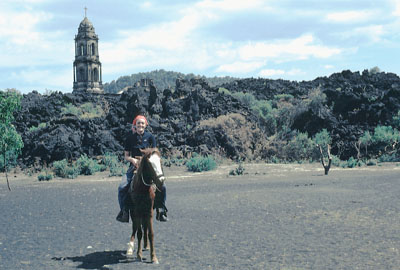
When I was about 7 years old, my parents bought me a set of Compton's Pictured Encylopedia. I think that they paid about eighty dollars for them, and they were my pride and joy. I frequently went to bed at night reading one of the volumes.
In my rambles through these books, I happened upon the story of Paricutin. Paricutin is a volcano in Mexico. I believe it is the eastern part of the country. It is a young volcano, having popped up in a farmer's field in 1943. Over several years the lava flow completely covered and destroyed a small village except for the top of the church steeple. It still remains active today but is no danger to populated areas.
When I was about fourteen, I went with my parents to Mexico. We went from the USA border to the tip of the country's southern parts. We also went to Paricutin! We drove to a small village about an hour's mule ride from the volcano, spent the night, and my dad and I got up at 4 AM to meet a guide. We rode on mules with wooden saddles. I remember that for sure! When we got to the edge of the cool lava flow, it was possible to get off and walk over to the church steeple at a level of the belfry and walk into it.
There were no people there but us. I'll bet that today, the place is covered with tourist traps.
13 October 2006
Mrs. Levy
Sometimes, I wonder why stuff like this pops into my mind. For some unknown reason, the other night I thought of Mrs. Levy. She was in my life for a few minutes about 63 years ago. That's right 63 years ago when I was 4 years old.
I don't know if there was a Mr. Levy, but there must have been one at some time because Mrs. Levy had a son. I don't know the son's name, and I am sure that I never saw him. I do remember his mother as a nice lady who lived across the street and down about 3 houses from us.
Why do I remember Mrs. Levy? She was the lady who baked cookies for us neighborhood brats on the day she got word that her son had been killed in Germany while serving in WWII. I just remember her bringing cookies out the back door for us on that morning that she became a Gold Star Mother. I wonder what her thoughts were now, but then, I just knew that she baked good cookies and loved us kids.
I remember Gold Stars in the windows of homes where a son had died in WWII. I think that Mrs. Levy's star was a Star of David.
I don't know if there was a Mr. Levy, but there must have been one at some time because Mrs. Levy had a son. I don't know the son's name, and I am sure that I never saw him. I do remember his mother as a nice lady who lived across the street and down about 3 houses from us.
Why do I remember Mrs. Levy? She was the lady who baked cookies for us neighborhood brats on the day she got word that her son had been killed in Germany while serving in WWII. I just remember her bringing cookies out the back door for us on that morning that she became a Gold Star Mother. I wonder what her thoughts were now, but then, I just knew that she baked good cookies and loved us kids.
I remember Gold Stars in the windows of homes where a son had died in WWII. I think that Mrs. Levy's star was a Star of David.
05 October 2006
Some of the Things that I Put into my Mouth
To begin; it is not my purpose to proselytize and encourage anyone to eat anything.
I have always been somewhat of an adventurer in culinary pursuits. At about age two, I became known as junebug because I ate one (I do not, thankfully, remember this). My nanny at the time confirmed this. One of my first adventures were raw oysters. I had seen my dad eat these but never asked for one. When I was about to become an intern, a hospital threw a bunch of us a beer fest. They had a guy opening oysters like a magician, and after a few glasses of beer, I tried one. Wonderful! Later on, I lived in a place where a guy who owned a seafood market and restaurant used to bring oysters back from New Orleans each week. One could get them in the shell to take home and shuck. Both my children were quite young and would stand with me at the sink, while I shucked away. My son loves them to this day. I think my daughter merely ate them to please me. A few years later, we were in a hotel coffee shop in Atlanta, and my son (he was about 8 years old) ordered a dozen on the half shell. The waitress asked if he would eat them, and when I said that he did at home, she asked if she could come back and watch. He is tired of hearing about that, but he can skip that part.
Some years later, I had a colleague who always had a game supper at his house once a year. That's where I was exposed to chitlins and prairie oysters. For those uninitiated, chitlins are a southern delicacy of boiled hog intestines that are battered and deep fried. Prairie oysters are the gonads of hogs or sheep (maybe other animals too) that are cut up, battered, and deep fried. They taste much like chicken nuggets and are yummy. This same game supper used to feature tomato gravy with venison heart in it. Wonderful over a biscuit.
In South Georgia, hunting rattlesnakes is a sport. One of the ladies in our office had a boyfriend who did this. Dressed and frozen, she would bring some to me. I have had it fried, but it tends to be dry. If the snake is boiled (it is VERY odifirous), the meat comes off easily and combined with sour cream and some black pepper, it makes a great dip. I have seen folks who wouldn't eat snake on a bet, scarf this stuff down and ask for the recipe.
After arriving in CH, I tried horse. It is a healthy red meat with almost no fat in it. My Godson's uncle used to be a horse butcher, so we had a ready source. It used to be that horse was not sold except in special markets. Nowadays, one can buy it in any meat or grocery market. It comes in several cuts. You can also buy foal, which is a bit more expensive and like veal would be. Horse is a dish for celebrations. Thinly sliced, it makes a great meat fondue, and a nice inch and one half fillet, cooked on the grill, and topped with some garlic butter will make a bulldog break its chain. My son enjoys horse (Pferd in German), but his wife is horrified when he neighs between bites.
Many years ago, I wanted to see how tripe tasted. Tripe is the lining of beef stomach. In the USA, it isn't commonly sold, or at least I could never find it. I did learn that a Campbell's soup called Philadelphia Pepper Pot contained tripe. I bought some and tried it. It was like eating pure gristle and did not seem to be pleasing on the tongue. I ate no more. Then, some time ago, I was with a friend at a mountain restaurant, when he noted with pleasure that Kuttlen (tripe) was on the menu. He said he did not get that at home because his wife thought that it contained too much cholesterol. He ordered it. The dish looked really good. Strips of tripe, cooked soft, and in a tomato sauce. I asked for, and received a taste. It was delicious! Since then, I have cooked it Napoli style in a pressure cooker. It has a tomato sauce, and I believe there is a recipe for it in The Joy of Cooking. One of Barbara's friends had me over for a Kuttlen lunch, and hers was like mine but with a bit of onion and melted cheese on top.
One of the things that I also enjoy is smoked tongue. While looking for it in the cold cuts section of our grocery, I came onto something called Euter. It looked a bit like tongue, so I bought it. I learned that Euter is German for udder. It must not be a big seller because I have never seen it again. It was nice on a cracker with a little mustard.
Eating is a learned event guided by what we see as we grow and experiment. Each group of people have built in likes and dislikes governed in large part, by our social mores.
The one thing that I cannot abide is boiled okra. My dad and mother ate it, but most of mine ended up in the toilet. I later learned to like it fried, pickled, and (the best), in an African curry.
I have always been somewhat of an adventurer in culinary pursuits. At about age two, I became known as junebug because I ate one (I do not, thankfully, remember this). My nanny at the time confirmed this. One of my first adventures were raw oysters. I had seen my dad eat these but never asked for one. When I was about to become an intern, a hospital threw a bunch of us a beer fest. They had a guy opening oysters like a magician, and after a few glasses of beer, I tried one. Wonderful! Later on, I lived in a place where a guy who owned a seafood market and restaurant used to bring oysters back from New Orleans each week. One could get them in the shell to take home and shuck. Both my children were quite young and would stand with me at the sink, while I shucked away. My son loves them to this day. I think my daughter merely ate them to please me. A few years later, we were in a hotel coffee shop in Atlanta, and my son (he was about 8 years old) ordered a dozen on the half shell. The waitress asked if he would eat them, and when I said that he did at home, she asked if she could come back and watch. He is tired of hearing about that, but he can skip that part.
Some years later, I had a colleague who always had a game supper at his house once a year. That's where I was exposed to chitlins and prairie oysters. For those uninitiated, chitlins are a southern delicacy of boiled hog intestines that are battered and deep fried. Prairie oysters are the gonads of hogs or sheep (maybe other animals too) that are cut up, battered, and deep fried. They taste much like chicken nuggets and are yummy. This same game supper used to feature tomato gravy with venison heart in it. Wonderful over a biscuit.
In South Georgia, hunting rattlesnakes is a sport. One of the ladies in our office had a boyfriend who did this. Dressed and frozen, she would bring some to me. I have had it fried, but it tends to be dry. If the snake is boiled (it is VERY odifirous), the meat comes off easily and combined with sour cream and some black pepper, it makes a great dip. I have seen folks who wouldn't eat snake on a bet, scarf this stuff down and ask for the recipe.
After arriving in CH, I tried horse. It is a healthy red meat with almost no fat in it. My Godson's uncle used to be a horse butcher, so we had a ready source. It used to be that horse was not sold except in special markets. Nowadays, one can buy it in any meat or grocery market. It comes in several cuts. You can also buy foal, which is a bit more expensive and like veal would be. Horse is a dish for celebrations. Thinly sliced, it makes a great meat fondue, and a nice inch and one half fillet, cooked on the grill, and topped with some garlic butter will make a bulldog break its chain. My son enjoys horse (Pferd in German), but his wife is horrified when he neighs between bites.
Many years ago, I wanted to see how tripe tasted. Tripe is the lining of beef stomach. In the USA, it isn't commonly sold, or at least I could never find it. I did learn that a Campbell's soup called Philadelphia Pepper Pot contained tripe. I bought some and tried it. It was like eating pure gristle and did not seem to be pleasing on the tongue. I ate no more. Then, some time ago, I was with a friend at a mountain restaurant, when he noted with pleasure that Kuttlen (tripe) was on the menu. He said he did not get that at home because his wife thought that it contained too much cholesterol. He ordered it. The dish looked really good. Strips of tripe, cooked soft, and in a tomato sauce. I asked for, and received a taste. It was delicious! Since then, I have cooked it Napoli style in a pressure cooker. It has a tomato sauce, and I believe there is a recipe for it in The Joy of Cooking. One of Barbara's friends had me over for a Kuttlen lunch, and hers was like mine but with a bit of onion and melted cheese on top.
One of the things that I also enjoy is smoked tongue. While looking for it in the cold cuts section of our grocery, I came onto something called Euter. It looked a bit like tongue, so I bought it. I learned that Euter is German for udder. It must not be a big seller because I have never seen it again. It was nice on a cracker with a little mustard.
Eating is a learned event guided by what we see as we grow and experiment. Each group of people have built in likes and dislikes governed in large part, by our social mores.
The one thing that I cannot abide is boiled okra. My dad and mother ate it, but most of mine ended up in the toilet. I later learned to like it fried, pickled, and (the best), in an African curry.
29 September 2006
Would You Believe It?
While Barbara is away, I have been watching the idiot box a lot. Well, we do that when she is here too. Anyway, two things hit me last night while watching "Prison Break" and one other serial.
First, since when do they have pay phones in prison yards? Did some legal eagle convince them that for inmates not to ba able to phone home is "cruel and unusual"? I wouldn't be surprised. My old dad always had two things to say about people in jails; one, they are not smart or they wouldn't be crooks, and two, jail is not supposed to be fun. I was further convinced of this when Chief Mainord, our town's police chief and neighbor, let me tour the local jail while I waited for the bus on Sunday mornings after Sunday School. Those Saturday night drunks never looked like they were happy. The place didn't smell good, and they all wanted to make phone calls. In that jail, there was no exercise yard. The only exercise that one got was walking in and out.
The other thing that hit me was that, in today's world, a man with hair on his chest is at a disadvantage. When I was a young sprout, I did everything but kiss my elbow, so that I would have hair on my chest, just like dad. Now, he wasn't an ape, but he did have a moderate growth there. The things that I did to insure trichosis on my chest would fill a small book. It was a sign of manhood, and I needed to be a man. The crusts on bread and eating all my carrots come quickly to mind. Later, I learned about genetics, so I still shed a few when I towel off. I am told that men today who want to be attractive get a wax job. I think that would feel a lot like old time adhesive tape being pulled off quickly.
No thanks!
First, since when do they have pay phones in prison yards? Did some legal eagle convince them that for inmates not to ba able to phone home is "cruel and unusual"? I wouldn't be surprised. My old dad always had two things to say about people in jails; one, they are not smart or they wouldn't be crooks, and two, jail is not supposed to be fun. I was further convinced of this when Chief Mainord, our town's police chief and neighbor, let me tour the local jail while I waited for the bus on Sunday mornings after Sunday School. Those Saturday night drunks never looked like they were happy. The place didn't smell good, and they all wanted to make phone calls. In that jail, there was no exercise yard. The only exercise that one got was walking in and out.
The other thing that hit me was that, in today's world, a man with hair on his chest is at a disadvantage. When I was a young sprout, I did everything but kiss my elbow, so that I would have hair on my chest, just like dad. Now, he wasn't an ape, but he did have a moderate growth there. The things that I did to insure trichosis on my chest would fill a small book. It was a sign of manhood, and I needed to be a man. The crusts on bread and eating all my carrots come quickly to mind. Later, I learned about genetics, so I still shed a few when I towel off. I am told that men today who want to be attractive get a wax job. I think that would feel a lot like old time adhesive tape being pulled off quickly.
No thanks!
Subscribe to:
Posts (Atom)